Passive or active? That is the question investors often ask. What they mean is, should I invest in a fund that is “actively” managed or should I invest in a “passive” fund that simply mirrors a market index? There are good arguments for both approaches, but more importantly, is that even the right question? The correct answer to the wrong question is still a wrong answer.
First, some background. Index investing has become increasingly popular. The concept is easy to understand and it has the advantage of being inexpensive. If the fund one invests in simply buys all the stocks in a given index, then there is no need to pay analysts to research companies. This allows for a reduction in the fees. It should be noted that there is no such thing as a free lunch. Many people will refer to index investing as buying the “market,” but this is not correct; the actual index exists only in theory. There are no transaction or management costs involved with the observation, and the tracking of stock returns in no way impacts the return in the real world.
Using an analogy, the index is just an observation, like standing on the bank of a river and observing the beauty. Watching the river does not change the river, but if one were to wade into the river, then his presence changes the river: the water must flow around his legs. Fish may become aware of his presence and try to avoid him or come to investigate this new obstacle. It may not seem like much, but once one enters the river, the river is no longer the same. The same phenomenon happens in the market. Index funds, whether they are mutual funds or exchange traded funds (ETFs), buy all the stocks in the index. Those transactions have a cost; they are low in our modern market, but still exist nonetheless, and as a result, the index funds do not perfectly track the index. The returns will always be slightly less than the index returns.
More importantly, those investments, like all investments in the market, have a greater impact. When those stocks are purchased (or sold), it impacts their return, which in turn impacts future investment decisions. In other words, there is no way to truly invest passively. The river will never be exactly the same once one wades into it, and the market will never be exactly the same once one invests.
Obviously, the smaller the investment the smaller the impact and the larger the investment the larger the impact, but every single transaction influences the market. So, is there any such thing as passive investing?
I don’t see it as much today as I used to, but many years ago it was common for us to meet a new client and hear that a parent had left them with shares in one particular company. Living and working in Atlanta, it was usually Coca-Cola. The parent bought shares many years ago and held onto them. Many times, they had taken physical delivery of the stock certificates and put them in a safe or bank deposit box. What had been a relatively small investment had grown into substantial wealth. That is passive investing.
That is not what index investing does. The various indices are made up of stocks of several companies, all of which are chosen either mathematically or by a committee. The most popular index, the S&P 500, is roughly the 500 largest companies in the United States, but the specific companies are selected by a committee to represent the larger economy. The committee rebalances quarterly and can make changes at any time. Today the turnover of stocks in the index is approximately 15 percent. In other words, approximately 75 of the S&P 500 companies are replaced every year.
In the 1960s before index investing existed, the average holding period of a stock investor was eight years. Today index investing is extremely popular and the average holding time of a stock in less than six months. In other words, the more people invest in index funds, the more “active” investors have become.
I know what you are thinking: This is a fascinating thought experiment, but everyone knows that “professional investors never beat their benchmark.” If only everyone “knowing“ something made it true (everyone used to “know” that the world was flat). The studies that show the outperformance of the index are almost all based on just one of many market indices, the S&P 500. It happens to be the hardest to beat, which makes sense logically as it represents 500 of the largest companies in the United States. These are the best-known, most researched companies in the world. It is almost impossible to have any advantage in knowledge about any of these companies.
The same is not true with smaller companies or companies headquartered in other countries. It certainly is not true with bonds, where buying every bond in the index is not usually possible as there are a finite number of bonds and they are all not for sale at any given moment. Professional managers in all of these categories tend to add value. We wrote about this in our fourth quarter 2010 Quarterly Report newsletter, “Indexing is Evil!”.
So, it is not as simple as many would like to make it out to be. Regardless we come back to the fact that there are increasingly more index investors while simultaneously the market has gotten more active. This is largely due to the move away from mutual funds and into ETFS. When index giant Vanguard founder Jack Bogle first wrote about index investing, investors chose to do so through low-cost mutual funds. Mutual funds are investment companies in which an investor can invest and the fund will, in turn, invest that money as described in a prospectus. In the case of the index fund, the prospectus would say that the proceeds would be invested in the stocks of the companies in the index. Investors can deposit more funds or withdraw funds daily at the end of the trading day. The structure of these funds leads to longer-term holding periods.
An ETF is a fund that sells shares directly on the market and thus can be traded any time the market is open, just like the underlying stocks themselves. The original purpose of the ETF was to give institutional investors a place to temporarily park money before allocating it to a portfolio manager who would then invest money on behalf of the institution. Once the ETF was introduced Wall Street found other uses, and today most index investing is done through ETFs.
Give Wall Street a new toy and it will figure out how to abuse it. The idea of index investing being a buy and hold, passive strategy went out the window with the popularity of the ETF. Today the most rapid traders in the market trade entire sectors instead of just one or two stocks through the use of various ETFs. There is a bit of irony in using what is labeled as a passive investment to be more active than investors of the past could even imagine.
This causes all sorts of short-term dislocation. One of the more popular market narratives today is the idea that AI will displace software. The strong form of this hypothesis says that people will just use AI to create custom solutions instead of buying software, in which case software companies are going out of business. The weaker version is that AI will greatly increase one’s productivity and therefore companies will need far fewer software seats, in which case software companies will simply have lower revenue as they sell less of their product.
I am not convinced that either of those cases will come to be, but as the saying goes, one cannot fight the market. In years past, traders who are acting on this narrative would have identified the weakest software companies and sold their stock short, while today they simply use a software ETF. This has the effect of strong software companies, even those who benefit from AI, having their stock thrown out with the bath water because they happen to be in the same ETF as companies that will not survive.
All of this creates an environment where, in my view, the market is becoming less efficient at accurately pricing individual companies. At the same time it is more efficient, if by efficient one means it is hard for active managers to beat.
Ultimately, this is the problem with index investing. We often forget why the stock market exists and the crucial role it plays in our system. The stock market is like a farmers market. Today’s farmers markets provide a place where local farmers, and increasingly local makers, bring their goods to sell to the public. It provides a central place for consumers to go, but it is mostly for the benefit of the farmers. Similarly, the stock market provides a place where companies can come to sell their stock. Yes, it also provides a central place for investors to shop stocks, but it is mostly for the companies. This is how capital is allocated in a capitalistic system. If every investor were to become an index investor, our system would cease to work: Instead of capital being allocated by merit, it would be allocated based on size, and the biggest companies would get the most investment. In other words, the rich get richer and it becomes harder for smaller companies to emerge.
We are not there yet, but with every additional dollar invested in an index, we get a step closer. At the end of the day there may be little difference between the central planning committee of a socialist country and the S&P 500 committee. When the broad market, in other words the general population, stops allocating capital and delegates that responsibility to a small group, the results are likely the same.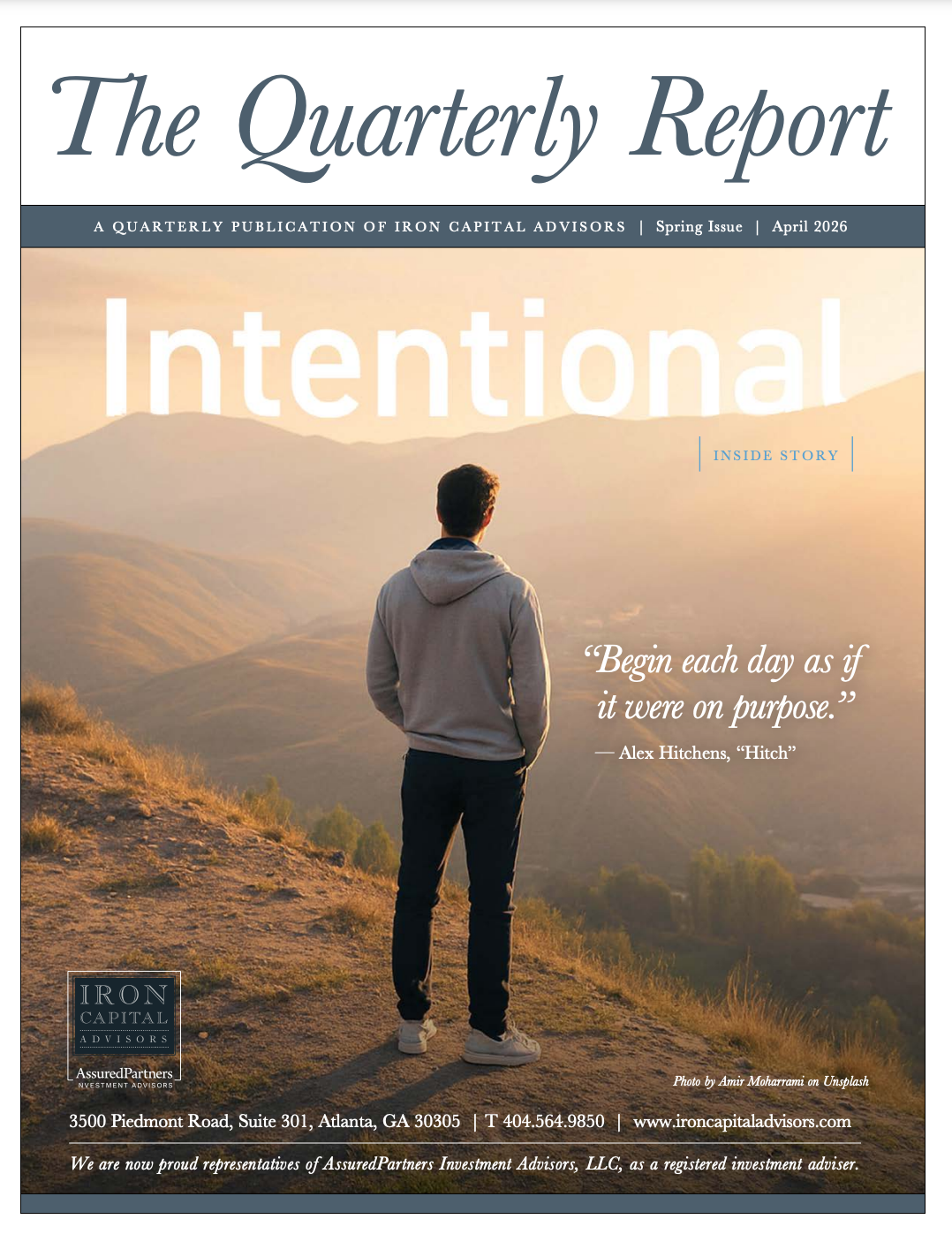
What are we to do? I would argue that the opposite of passive investing is not active investing, but intentional investing. A rewarding life is a life lived with mindful intention. This is why we believe that prudent investment is done from the ground up: We should select the companies to which we want to allocate our capital with purpose and intention. When we cannot do that directly, such as in a 401(k) plan, then we should use managers who still invest in this manner.
Then we should bring the passive back to passive investing: Invest in high-quality companies and own them for long periods. Over the last five years, Nvidia’s stock is up more than 1,000 percent. How many investors have owned that stock for the whole period? There have been large ups and downs, with the stock dropping one point approximately 70 percent. It isn’t easy being passive. Selecting high-quality companies and holding them for long periods is a wonderful way to invest, if one has the discipline.
That does not mean that every investor who does so will beat the market, but if done prudently with a focus on the return needed while being risk averse, these investors have a great probability of achieving their financial goals. To paraphrase Benjamin Graham, achieving an adequate return is easier than most people think; achieving superior returns is harder than it looks. I have been helping people achieve their goals for more than 30 years, and I have yet to meet the investor whose financial success depended on beating the market.
There is a scene in the 2005 romantic comedy “Hitch,” when Will Smith’s character, Alex, tells Eva Mendes’ character, Sara, to, “Begin each day as if it were on purpose.” It is a line taken from author Mary Anne Radmacher. We should invest that way, too. The next time you make an investment, including reallocating your 401(k), do so as if it were on purpose.
Warm regards,

Chuck Osborne, CFA
The 4th quarter 2025 GDP growth came in up 0.7 percent, significantly below expectations. GDPNow shows the economy growing by 1.3 percent in the 1st quarter, so economic growth has slowed. The impacts of haphazard economic policy and the war in Iran are showing up in the data.
The official unemployment rate was 4.3 percent through March. The economy created 178,000 jobs. That is still below the long-term norm, but an improvement over recent data. We remain in a strange place where the jobs market is not great but the unemployment rate is staying low.
Inflation is 2.7 percent based on the latest consumer price index report. Inflation is no longer dropping. It has stayed closer to 3 percent than the 2 percent goal of the Fed. The producer price index is now 3.4percent. +
The market was mixed in the 1st quarter. For the quarter the S&P 500 finished down 4.33 percent, while small company stocks represented by the Russell 2000 index were up 0.89 percent. Value outperformed with the Russell 1000 Value index up 2.10 percent while the growth index was down 9.78 percent. For small companies value was up 4.96 percent, and the growth index was down 2.81 percent.
Bonds dropped slightly. The Bloomberg U.S. Aggregate Bond index ended down 0.05 percent. High yield bonds were down 0.55 percent. Bond yields rose.
International stocks were down but better than S&P. The EAFE index finished down 1.12 percent and the MSCI Emerging Markets index ended the quarter down 0.10 percent. +
We are getting a correction in the S&P 500 and are in a bear market for software stocks. At the same time value stocks, smaller company stocks, and international stocks have held up. We have been right on the allocation front. The question now is how long does this correction last?
The answer depends on Iran, and is therefore unknowable, however the initial rebound will likely help those who have been most beaten up, software companies. Afterwards, we believe the longer-term trends will hold with the move to value, small, and international having legs.
Bond yields have risen in the short term, as we entered a sell everything mode. This now makes yields more attractive. With inflation being higher we would not be surprised if the Fed remains paused leaving rates steady. +
