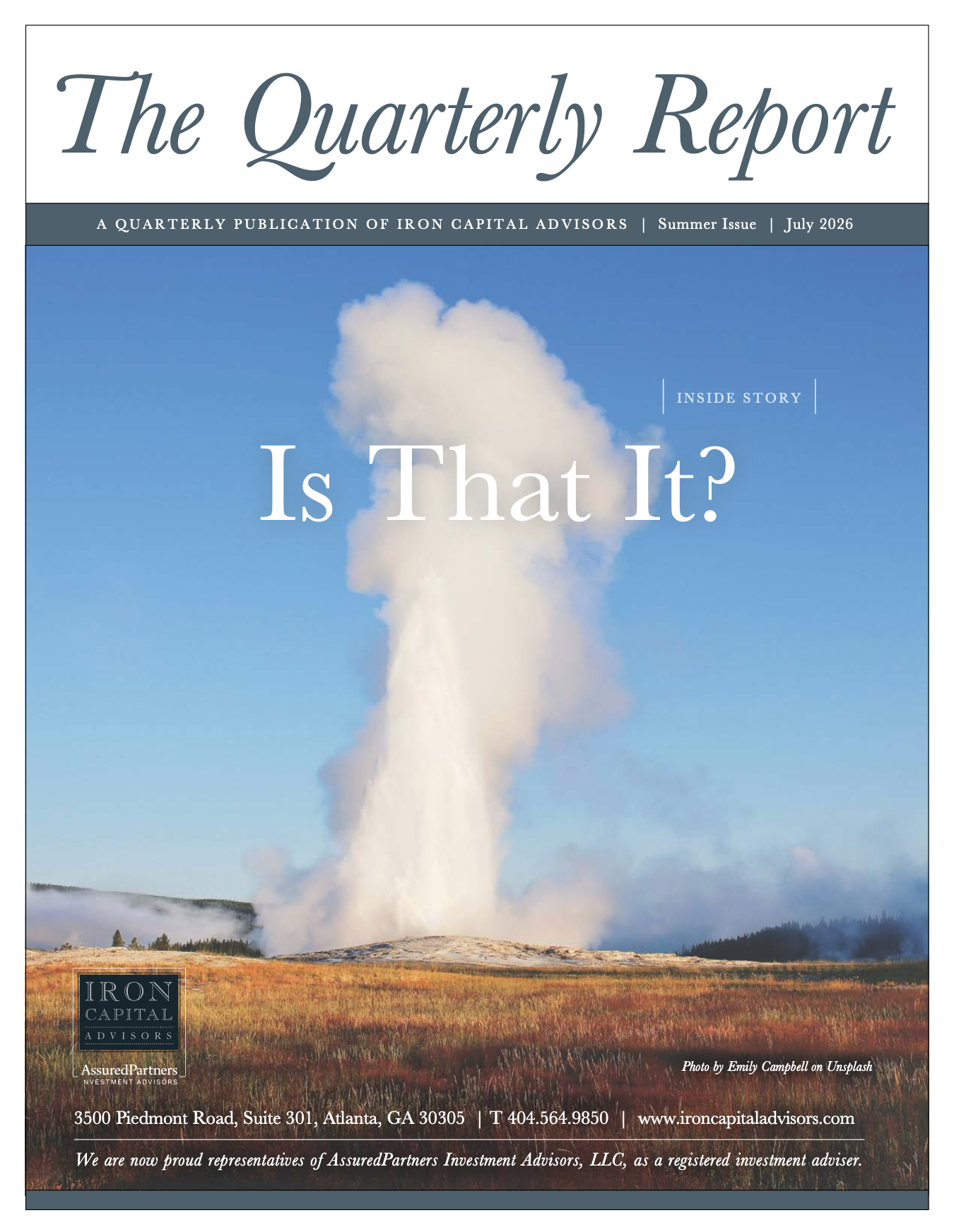
Have you ever seen Old Faithful, the famous geyser in Yellowstone National Park? I saw it with my family when I was in college. We took a family ski trip to Montana and after a few days on the slopes, several of us piled into a car and headed to Yellowstone. Just outside the park we rented snowmobiles. My understanding is that this is no longer allowed.
We cruised into the park on our snowmobiles, going slowly and stopping often to check out the wildlife and the scenery. It was beautiful, and we saw elk, eagles, and buffaloes – a lot of buffaloes. Finally, we reached our destination: Old Faithful, the legendary geyser. Time came for the geyser to do its thing and…nothing. We had to wait another 10 minutes or so, when finally water shot up in the air. We all stood there and collectively went, huh. Memes were not a thing back then, but in today’s world I would say that Old Faithful was decidedly meh. We then raced our snowmobiles back (so, no more snowmobiles in Yellowstone, sorry).
Sometimes getting to where you are going can be a bit of a letdown. Even something as special as winning an Olympic medal or the World Cup can end up being disappointing, even to the point of depression. Michael Phelps, the greatest Olympic swimmer of all time, has gone public with his battles over depression after his triumphs. He worked so hard and devoted his life to this singular pursuit, achieved it, and then woke up the same person he had always been.
Psychologists call it the “arrival fallacy.” This is the false belief that reaching a specific goal or milestone will bring lasting happiness. The problem comes when we attach our worth and/or happiness to an outcome. When we do that, we fall victim to two psychological forces.
Hedonic adaptation is the first force. Our brain is designed to adapt quickly to new circumstances. Once the initial thrill of reaching a goal fades, our happiness resets to our baseline, “normal” state. I remember Phil Mickelson winning the Masters, arguably the most prestigious championship in golf. The Monday after the tournament he was photographed in the drive through of a doughnut shop; Sunday night he might have been the Master’s Champion, but Monday morning came and he was just Dad, and his girls wanted doughnuts. We come back to earth quickly.

We are also wired to reward pursuit over arrival, which is the second force. Neurologically, our brains reward the progress and struggle of striving towards a goal, rather than the act of getting there. I have run the Chicago marathon. It was an achievement and to this day it is the furthest I have ever run.
I have multiple stories from that experience, but none really involves crossing the finish line, though I have often marveled at how much I was able to eat that night. When you train for a marathon, people will tell you that you run 20 miles and then you run a 10k. While I had never run 26.2 miles before that day, I had run more than 20 miles multiple times in training, and I have run countless 10ks; this time I was just doing it with the city of Chicago cheering me and the thousands of other runners on. The race was on a Sunday. Monday I flew home to Atlanta, and I was at work on Tuesday. From that day on I can say I ran a marathon, which, combined with a valid credit card, will buy a coffee at Starbucks.
More importantly, it showed me a great truth: Running a marathon is not much of an achievement; successfully training for a marathon is a great achievement. Running that Sunday 24 years ago was actually fun, while the struggle was the multiple Saturday long runs by myself or with a few partners – no one cheering, no one lying and telling you, “Only one more mile,” no one randomly passing out beers at mile 22; just you and the road for mile after mile. That is the achievement.
This brings us to retirement. After all, that is the goal of all of this investing, isn’t it? We just need to make it to retirement. In my practice we have had the good fortune of helping many people retire, and most who do so have put in those miles. They do everything right: They live within their means, save, and invest. They joined their employers’ retirement plan early and contributed as much as they could.
They visit with us and create detailed financial projections and model all kinds of contingencies. Then the day comes, and they finally do it: they retire. My father met that description. He retired at roughly the age of 65. It lasted for approximately six months and then he went back to work. He was around 80 when he finally retired for good. That final retirement lasted 14 years. It was not an easy transition for him, and he is not alone.
I was recently shown a YouTube video by a so-called retirement influencer who claimed that the “you will be bored” reason for putting off retirement is a myth. That may well be true for him, but speaking as someone who has been helping people do this in the real world for more than 30 years, lots of people struggle with retirement. Many don’t, and great for them; but for those who do, it is often a case of “arrival fallacy.” They think everything will be fixed by no longer having to go to work, yet they find they are the same person with the same problems, but they no longer have a job that gives them meaning and social interaction.
Arthur Brooks is an author and Harvard professor whose main area of research is happiness. He says that there are three “macronutrients of happiness:” enjoyment, which comes from a balance of pleasure and engagement; satisfaction, which he defines as the feeling of working hard to achieve a goal and successfully reaping the reward; and meaning, or having a sense of purpose and coherence in your life.
Most of us get at least some of those “nutrients” from work. Work provides deep engagement; it puts us into the striving towards something mode, even if that something is just the day when we don’t have to work anymore; and it gives us a sense of purpose and coherence.
No wonder retiring can be a challenge. Too few advisers engage with their clients about these non-financial obstacles. What are you going to do when you are retired? There is a limit to how much golf you can play, and sipping cocktails on a beach is fun in moderation, but if that is your idea of retirement, you might want to investigate rehab facilities now.
The failure to have a realistic life plan for the retirement years is, in my opinion, the primary cause of one of the biggest pet peeves of many financial advisers: Getting their clients to finally spend their money. Those who are financially ready to retire have made the habit of always saving, always investing, always planning and optimizing. The purpose of all of those good habits was to get her to the destination and now that she is there, it is just meh.
She wants to be striving towards the goal; that is where real joy lives. She wants the enjoyment of deep engagement and the satisfaction of working hard. Making it to retirement provided meaning and purpose. Now we are here, now what? Let’s keep planning, keep running scenarios, keep optimizing.
Wall Street will encourage such activity. Wall Street makes money on transaction volume. They don’t want clients to spend their money, since they can’t charge money that has been spent. They don’t want clients settling on one retirement strategy that works, because they make money on transactions, and the more rebalances and more optimizations, the better. Legendary investor Michael F. Price said it best, “Wall Street is in the business of generating fees for Wall Street. Period. It’s not in the business of getting good investment results. You have to separate from Wall Street to do that.”
This is especially true in retirement, and clients are not the only ones who struggle with retirement. The investment industry still cannot figure it out. In our recent podcast we had the pleasure of being joined by Andrew Jacobs van Merlen, co-portfolio manager of T. Rowe Price Target Date Strategies. He and his colleagues manage more than $585 billion in retirement assets. He pointed out that the industry, which now manages $5.2 trillion in retirement date options, still cannot figure out “retirement” because everyone’s retirement is unique.
What most have done is just kept investing like they did in the accumulation phase and hope the total return is higher than the income needs. In our experience this just adds to retirement anxiety – the psychological need to keep acting like we are not there yet. The underutilization of resources, the constant need to reevaluate. This is why we use our income strategy to generate the income needed and not rely on capital appreciation: it allows the retiree to know that the income will be there even in a bad market.
Still, a successful retirement requires more than just financial ability. We must find new ways to sustain those macronutrients of happiness. What will bring us enjoyment, satisfaction and meaning? That answer is different for just about every individual. One size does not fit all. Travel isn’t enough, unless you are going to travel slowly by sailing around the world and staying in places for months at a time – then it could take a decade, but most modern travelers take trips which last days, maybe weeks. Even if you travel two full months out of the year, there are still 10 more months. Hobbies help, but there is only so much golf to be played.
To be successful in retirement, we need to make it our next stage of life and not a destination. As such, the challenges of making life meaningful remain the same. It may not be a gold medal. In today’s world you might not even get the gold watch, but retiring is an achievement. Once the immediate celebration is over, we are all going to wake up being the same people we were before. Each of us has to find our path to meaning. If you think yours is a trip to Yellowstone to see Old Faithful, be warned; you might be disappointed.
Warm regards,

Chuck Osborne, CFA
Managing Director
The 1st quarter 2026 GDP growth came in up 2.1 percent. GDPNow shows the economy growing by 1.3 percent in the 2nd quarter, so economic growth has slowed. The impacts of haphazard economic policy and the war in Iran are still showing up in the data.
The official unemployment rate was 4.2 percent through June. The economy created 57,000 jobs, a weak
number after two positive surprises. We remain in a strange place where the jobs market is not great but the unemployment rate is staying low.
Inflation is 3.5 percent based on the latest consumer price index report. Inflation spiked due to the war in Iran and now seems to be settling back down. The producer price index is now 5.5 percent. +
It was a record-breaking quarter. For the quarter the S&P 500 finished up 15.20 percent, while small company stocks represented by the Russell 2000 index were up 21.49 percent. Growth outperformed with the Russell 1000 Growth index up 16.74 percent while the value index was up 13.87 percent. For small companies value was up 17.19 percent, and the growth index was up 25.71 percent.
Bonds were positve. The Bloomberg U.S. Aggregate Bond index ended up 0.67 percent. High yield bonds were down 2.45 percent. Bond yields rose slightly.
International stocks were also up. The EAFE index finished up 11.08 percent and the MSCI Emerging Markets index ended the quarter up 24.15 percent. +
After a record-breaking quarter, one would expect the market to slow. However, keep in mind we dropped in the 1st quarter for reasons unrelated to actual corporate results. Year-to-date, we are up modestly and in many cases up less than the actual business results. We remain cautiously bullish.
Iran is still happening even if the market is ignoring it at the moment. That should help energy stocks as supplies remain somewhat constrained. Small companies and emerging market companies have great momentum and we still believe the long- term trend is towards these areas and away from large U.S. stocks.
Bond yields have risen slightly, and this makes them more attractive going forward. We were right about the Fed staying put and we suspect this will stay the same. We are doubtful of an actual rate increase, but there will be chatter if inflation does not come back down. +