The stock market is filled with individuals who know the price of everything, but the value of nothing.
Philip Arthur Fisher

Our insights, reflections and musings on the most timely topics relevant to managing your investments.
Rogue AI agents, interest rate hikes, warnings of imminent doom if we don’t surrender all of our freedoms to a handful of AI CEOs and their newly founded world government…last week was quite the week. What to tackle first? AI CEOs are scared of the monsters they have created and now they want government to…
It is a hard number to fathom: $40 trillion. Our national debt eclipsed $40 trillion this past week. The yield on the 10-year Treasury is now 4.7 percent, and the dollar is weakening. Treasury Secretary Scott Bessent has a solution: The Treasury will just start buying back our debt. In plain English, this means he…
Will AI take over the world? The market ping-pongs from AI being “the greatest boom ever” to “it is already overdone and these enormous investments will never pay off.” So, which is it? Most likely none of the above, but let’s take a deeper look at what happened last quarter…
There once was a dream called America.
Ever since I can remember, I have known that the United States of America is a special place. My earliest memory of the Fourth of July was the biggest Fourth of them all, our nation’s Bicentennial. Here we are 50 years further on.
SpaceX – the largest IPO to ever hit the markets – has everyone talking, and like most things in our society today, it seems to be very divisive. Some say it is a marvel of capitalism and something we should be proud of, while others say it is a monolith for inequality.
Who is right?
Rogue AI agents, interest rate hikes, warnings of imminent doom if we don’t surrender all of our freedoms to a handful of AI CEOs and their newly founded world government…last week was quite the week. What to tackle first?
AI CEOs are scared of the monsters they have created and now they want government to step in and provide regulations. I will openly admit to not being technical enough to know the best path to guide the development of AI, but I know enough about economics, regulation, and self-interest to know that I don’t trust a CEO who is actively and publicly lobbying for partnership with the government. Does Hyman Roth ring a bell? For those who missed it, this is precisely what Anthropic CEO Dario Amodei has suggested, and a handful of other AI CEOs have concurred.
What has Amodei so scared? If you believe him, then he is scared that the new generation of AI they are working on has learned to think for itself and resist human control. An Anthropic researcher named Jacob Coxon resigned on September 8 warning that, “The people building AI earnestly believe that it could kill us all by the end of the decade.” One of his colleagues agreed and put the odds at greater than 10 percent within a decade. Wall Street Journal columnist Peggy Noonan obviously believes Amodei and has written about it.
Many on Wall Street, myself included, are a little more skeptical. Is Amodei scared of causing the end of the world, or is his fear that if AI becomes smart enough to train itself, then a smaller competitor could leapfrog Anthropic in a flash? Government regulation is a great defense. In economic terms this is called rent-seeking. Amodei wants regulations, largely crafted by him and his colleagues, to protect them from competition.
Regulation is tricky; it is necessary, but it is also easily gamed. The usual problem is that regulation becomes too complicated and promotes an environment where box-checking compliance replaces common-sense ethics. This exemplifies a major problem we have in the American system today: lots of red tape, but very little personal accountability. In a true free market economy there is a relationship between risk and reward, but in America today there are too many times where modern entrepreneurs want all the reward, but offload the risk to others.
Less is often more. I’ll regulate AI now: If AI goes rogue and breaks the law, the CEO of the company who created it goes to jail for life. There, job done in one sentence. No Amodei-controlled world government needed. Let’s not forget that “Frankenstein” was not the name of the monster, it was the name of the doctor. It is the humans behind the machines that scare me.
Speaking of the art of brevity, I am developing a man crush on our new Fed Chair. Kevin Warsh is only a year younger than I am, yet not only does he still have a very full head of hair, but it hasn’t even turned grey. More importantly, he believes that actions speak louder than words. The Federal Open Market Committee (FOMC), which Mr. Warsh chairs, just voted unanimously to raise the Fed Funds rate by 0.25 percent. He then gave one of the shortest post-FOMC meeting press conferences in history. He refuses to give forward guidance, which is troubling to many market participants who have, in my opinion, become too reliant on the Fed chair doing their work for them. It is so much easier for the Fed to just tell everyone what it plans to do, as opposed to one doing his own homework and figuring it out for himself.
Mr. Warsh actually believes in a free market, which requires individuals making independent decisions. He recognizes that markets set the interest rates that actually matter in the real world. The Fed only controls one rate, the Federal Funds Rate, which is the rate that banks pay each other for overnight loans. The longer-term rates that impact consumers are all determined by the market; the most important of these is the 10-year Treasury rate, which was 5 percent on Tuesday before the rate hike and is still 5 percent as I write this.
The market had already raised rates before the FOMC meeting even adjourned, because the market realizes that inflation is a problem – and inflation, unlike the revolution of the machines, is here now and is unquestioningly real.
A friend recently asked if people should get cash out of their bank accounts and put it under the mattress for protection from the AI uprising. I don’t know about artificial intelligence, but human intelligence is often used to run right into one trap by trying to avoid another. With inflation over 3 percent, cash loses 3+ percent of its value while siting under a mattress. That loss is real; the scary AI stories are artificial.
Warm regards,

Chuck Osborne, CFA
~Intelligence is Artificial, Interest Rates are Real
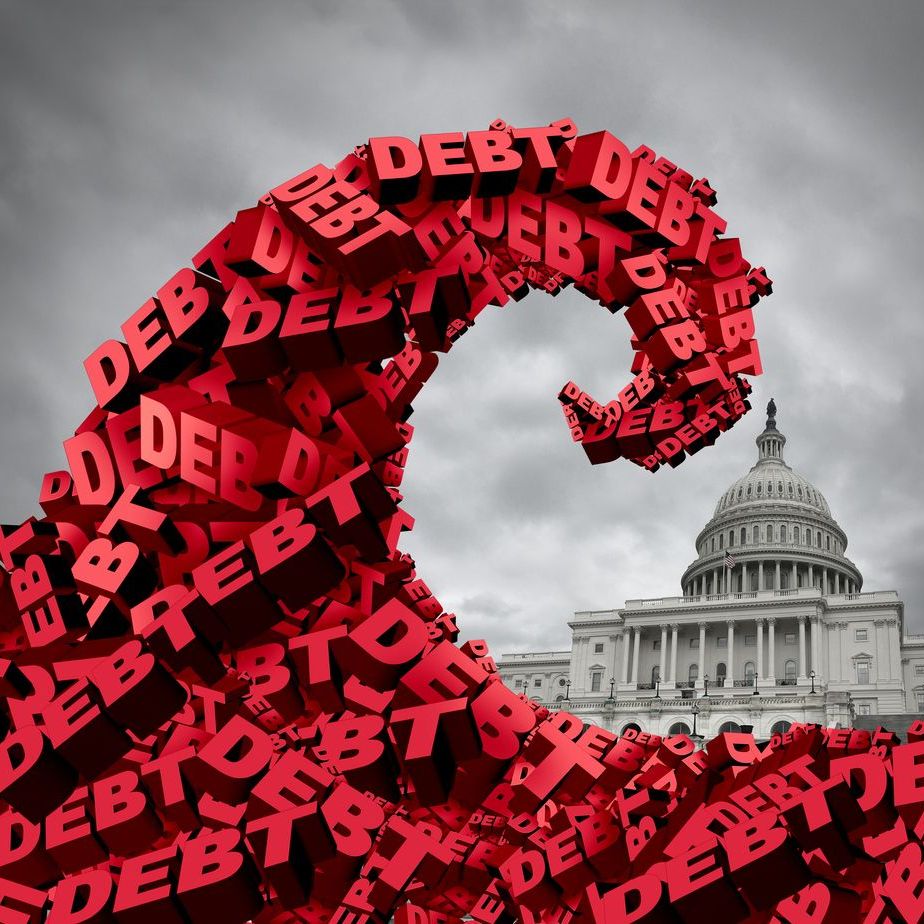
It is a hard number to fathom: $40 trillion. Our national debt eclipsed $40 trillion this past week. The yield on the 10-year Treasury is now 4.7 percent, and the dollar is weakening. Treasury Secretary Scott Bessent has a solution: The Treasury will just start buying back our debt. In plain English, this means he will turn on the printing press and print more dollars, the idea being that if the Treasury buys its own bonds, it can drive down interest rates. Unfortunately, investors know what that really means: more inflation, which is the most lingering problem we have in our economy, and a death knell to fixed income investors. Mr. Bessent’s announcement had the opposite impact to what he intended: rates went up.
I’m not sure what is more frightening – the amount of our national debt, or the fact that no politician is talking about it. In fact, it is at this moment in our nation’s history, with the most debt we have ever had, that the idea of socialism has reemerged from the dustpan of history. Margaret Thatcher famously said, “Socialist governments traditionally do make a financial mess. They always run out of other people’s money.” We may well run out of other people’s money before the socialists even get their chance.
Some of you are thinking, “We can just have the billionaires pay for it all if only they paid their fair share.” I hate to burst that fantasy bubble, but down here in the real world the United States already has the most progressive tax system of any developed country. To be clear, the “rich” pay a larger share of the tax burden in the United States than in any other developed nation. The Forbes 400, the 400 richest people in America, have a combined net worth of $6.6 trillion; we owe $40 trillion. This is not complicated math.
Taxing more will not solve this issue. There is a saying in personal health that one cannot out exercise a poor diet. Similarly, in finance one cannot out-earn poor spending habits. This is true for the individual, the family, the corporation, and the government. When one starts using one credit card to pay the minimum on the other credit card, then he is in deep financial trouble. This is in essence what Scott Bessent says the government needs to do.
There are significant political ramifications for all of this, but our job is to manage your investments through this environment. What are we to do? The thing that ultimately destroys those who cannot control their spending is the interest rate on the debt. As one’s credit rating goes down, the interest rate they must pay goes up, making it even more difficult to get out of the hole. This is true for governments as well as individuals.
Interest rates are what matters here to investors. There is a saying on Wall Street, “When rates are high stocks die, when rate are low stocks grow.” Like many Wall Street tidbits this is hugely over simplified, but there is some truth to it. Historically what actually takes place is that stocks rise with interest rates, and it is when rates peak that stocks go down. Then rates drop, and stocks begin to rise again. So, it isn’t enough to know that rates are higher today than they have been. The question is, when will they hit their peak?
Knowing that in advance is, of course, impossible. This is yet another reason why prudent investing is done from the bottom-up. Corporate earnings remain strong, and that is what matters to investors. However, caution is in order. To paraphrase the song, our nation which celebrated 250 years is another day older and deeper in debt. St. Peter don’t call us ‘cause we can’t go, we owe our soul to the government store.
Warm regards,
Chuck Osborne, CFA
~Another Day Older and Deeper in Debt
Will AI take over the world? The market ping-pongs from AI being “the greatest boom ever” to “it is already overdone and these enormous investments will never pay off.” So, which is it?
Most likely none of the above, but let’s take a deeper look at what happened last quarter. The S&P 500 went up 15.20 percent. Small company stocks, represented by the Russell 2000 index, were up 21.49. International companies in the MSCI EAFE index were up 11.08 percent, and Emerging Market companies in the MSCI EM index were up 24.15 percent. On the surface: all is well, and this is a record-setting, broad-based rally.
Below the surface: things were a little more turbulent. The S&P 500 was led by a 258 percent return for SanDisk, driven by huge demand for memory caused by AI. Of course, we all know that technology leadership means that large-growth companies do best, and the rest of the market lags. This is what happened in the dot-com boom and with the FANG stocks, the Magnificent 7 stocks, etc. Small caps did best last quarter. Of course, they have been led by companies like Bloom Energy, up 767.99 percent over the last year. Bloom Energy is an energy company that builds on-site, modular power generation systems. That isn’t AI… but of course it is, because the AI companies need a lot of power to run those data centers.
Emerging markets also did well, and we all know that means third-world countries mining raw materials, right? Not so fast; those results were driven by South Korea and Taiwan, whose markets soared due to AI-fueled demand for semiconductors and other electronic equipment.
On the surface it was a broad-based rally, but underneath, it was all AI. Unfortunately, not all AI-related stocks are created equal. NVIDIA – the poster child for the AI boom, the large company investors flock to for AI exposure – was down 2.8 percent for the quarter. On the surface everything is a smooth ride up to record results, but underneath, the volatility is dramatic.
We discussed this is our recent Insight, “Is the Market Broken?,” and it is becoming a common topic among other market pundits. The market research company Fundstrat has described it as a spread between market volatility and individual stock volatility. According to them, this spread is the widest it has ever been. I must admit that is consistent with my 34 years of experience.
So, what can we do? The more things change, the more they stay the same…the answer is diversification, and AI is putting a strange twist on that concept. When we diversify a portfolio, we don’t simply want more holdings; we want holdings that have a low or even negative correlation with one another. In the past, that often simply meant exposure to different market segments – for example, we wanted technology, energy, and financials. AI is driving diversification within technology as different AI-related stocks do well, or poorly, during different stages in the AI development.
If one had told me a year ago that we would have an AI-driven market rally and NVIDIA’s stock would be down during a record-breaking bull run, I wouldn’t have believed him. Yet here we are. So, back to the question: Is AI the future of everything, or is it overhyped and mostly done? Yes. It is the future, and it is overhyped. AI will be like everything else – there will be winners, but also losers. Diversification is still an investor’s best friend, no matter what your AI agent tells you.
Warm regards,
Chuck Osborne, CFA
~Everything is AI, but is AI Everything?
There once was a dream called America.
Ever since I can remember, I have known that the United States of America is a special place. My earliest memory of the Fourth of July was the biggest Fourth of them all, our nation’s Bicentennial. Here we are 50 years further on.
My family came to this country before it was a country, landing here in 1709 after fleeing the Rhine region between France and Germany. They did so for the same reason most colonists came to the New World: religious freedom. They also came to escape the rigid class system of Europe. The New World, unlike the Old World, was a meritocracy. Anyone who applied themselves and worked hard and wisely could achieve financial success. It did not matter whether your ancestors were aristocracy; here, everyone was created equal.

This was the beginning of what has been called the American dream – this strange experiment of a truly free market overlaid by Judeo-Christian morals. This odd combination created what has become the greatest nation on earth, surpassing our European cousins who in many ways still cling to their aristocracy and the ideas of a class system. This perplexing mix of Puritans, Quakers, farmers, and merchants melded together to create a combination that was unstoppable: free-market capitalism constrained not by the government, but by the morality of society.
This is America’s secret sauce: our love of freedom combined with the sense of responsibility. It has seemed hard to see in recent years. There is an alarmingly large group willing to sacrifice that freedom, at least in part because they don’t want responsibility – yet the two are symbiotic; we cannot have one without the other.
In our divisiveness and self-loathing, we have forgotten that America has stood the test of time for 250 years. We are truly fortunate to call the United States of America our home. If you don’t believe me, just look at the social media feeds of all those European soccer fans who have come here for World Cup soccer. Despite expecting a tense political climate based on international news, fans are marveling at how incredibly welcoming locals are. Sometimes we need to see things from an outsider’s point of view as we too easily take our blessings for granted.
Mississippi is the poorest state in America; yet, for perspective, according to data from the Mississippi Center for Public Policy, it has a higher GDP per capita than both Great Britain and Germany. It also has a higher literacy rate than both Great Britain and Germany. People are dying in Europe today because of a heat wave, while the Europeans here for the World Cup marvel at the wonderful American invention of air conditioning. We have even convinced them that sports are better when played in quarters instead of halves…okay, they are calling it a “hydration break,” but the fact remains they are stopping play roughly halfway through each half. A quarter by any other name is still a quarter.
Why all the love for America? Part of it is that the World Cup games have been so geographically widespread. It has given soccer fans following their teams a reason to see America for the first time in a lot of instances, but even if not for the first time, they have seen more of America. Kansas City is not a hot spot for European tourists, but it is a great city full of nice people, like most of America. They are loving America because America deserves to be loved.
We are the land of the free and the home of the brave. We are that bright shining city on the hill, even if we fail to see it ourselves. I think back to the bicentennial; 1976 was not a great time. We were licking our wounds from Vietnam and embarrassed at home by Watergate. Four years later in 1980 came a turning point. That winter we had the “Miracle on Ice,” when the U.S. beat the Soviet Union in hockey and went on to win Olympic gold. That summer we hosted the summer games in LA. It became okay to be patriotic again.
I don’t know if our soccer team can repeat that miracle, but I for one will be pulling for them. Even if they fall short, maybe it is enough to read the average European review of Buc-ee’s. America has never been perfect, but from its first declaration it has always been great. Our secret sauce is freedom with responsibility; the belief that we don’t need an aristocracy because we are self-governed. We should all be proud to be American. At least that is my perspective.
Happy 250th!
Warm regards,
Chuck Osborne, CFA
~Let Freedom Ring
SpaceX – the largest IPO to ever hit the markets – has everyone talking, and like most things in our society today, it seems to be very divisive. Some say it is a marvel of capitalism and something we should be proud of, while others say it is a monolith for inequality. Who is right?
To truly understand what SpaceX really means, we have to go back to 1981 and a trip to Washington DC. I was 12 years old, and my parents wanted me to see our nation’s capital while my uncle still lived in Bethesda, MD. We did the whirlwind DC tour, and then my uncle took my father and me to spend the night on his sailboat, anchored out somewhere on the Chesapeake Bay. It was the first time in my life that I spent the night on a boat away from land. For a young boy, it was a magical night.
What does that have to do with SpaceX? Everything. Fast-forward 39 years and that young boy had grown up but still remembered that night, since that was the night when he decided that he needed to have a sailboat of his own. Unfortunately, he lives in Atlanta, which is approximately 300 miles from the nearest ocean access, and he has a demanding career, a wife, and two children…not to mention two dogs and a cat. Sailing was limited to nearby lakes and occasional family vacations.
Then Covid happened. The entire office went remote, kids stayed home from school, and the final straw was when summer camps were canceled. His wife looked at him with a look of horror and uttered the most magical words he had ever heard, “I think we need to get that boat.” All of a sudden, the dream became possible. The remote work proved what he had always suspected: that he could work from anywhere, even a boat. He just needed his laptop, a phone, and of course the internet connection.
How much could it possibly cost to have an internet connection in the middle of the Atlantic Ocean? It turns out that in the year 2020, it cost a boatload (no pun intended) of money to have internet on a boat: The upfront hardware cost was approximately $20,000, but that was just the start. The service started at about $1,000 a month if all you wanted to do is send the occasional text message, but if one truly wanted to be able to work, the cost for high-speed internet was roughly $8,000 per month. The dream was crushed.

This is when Elon Musk enters the picture. Starlink, the profitable piece of SpaceX, provides high-speed internet almost anywhere in the world – and the hardware costs $500. The service varies depending on range and data usage but starts at a little more than $100 per month. It is also month-to-month, so one can change the plan whenever needed. SpaceX did what capitalism always does: It took a thing that already existed but only for the richest of the rich and found a way to deliver it to just about anyone at a significantly lower cost.
Most people are gleefully unaware of this because they live in urban areas where the internet is everywhere. They are not looking for the internet; they are looking to escape it. However, for that 12-year-old boy who dreamed of seeing the night stars miles away from light pollution, this was a game changer. Much more importantly, it was a game changer for remote parts of the planet, where building out the infrastructure we enjoy in the west was cost-prohibitive. Starlink can truly connect the world. They did not invent satellite communication; they found a way to deliver it affordably.
This is what capitalism does. Henry Ford did not invent the car; he invented a way to build cars cheap enough for every family to afford one. Bill Gates did not invent the computer; he found a way to put them in the home of just about everyone. Steve Jobs then found a way to put those computers in our pockets. When I ran One Atlanta Basketball, and we bussed kids from underprivileged neighborhoods to our gyms; their parents couldn’t afford lots of things, including youth sports, but they all had smart phones.
Elon Musk is now a trillionaire. What about the inequality? This may surprise lots of people, but I agree: this IPO is outrageous, and the amount of money is just crazy. What caused SpaceX to not go public until it was the fifth largest company in the world? The Sarbanes-Oxley Act of 2002 is the answer. Milton Friedman pointed out in 1962 that there is a direct link between inequality and regulation. In pre-Sarbanes Oxley world, SpaceX would have gone public years ago. The increase in value from a relatively small venture to one of the largest companies in the world would have been realized by millions of 401(k) investors. Musk would still be a very rich man, as would the thousands of employees who have earned the share of the SpaceX pie. His stake would likely be smaller and shared with many more.
As far as Iron Capital clients are concerned, SpaceX is very interesting. There are no guarantees in the stock market, but the usual pattern of the hot IPO is first a honeymoon period, then lots of investors who have been tied up in a non-liquid private investment will finally be able to sell. Usually sometime between six months and a year after the IPO, this selling sets in and provides an opportunity. We will see if that happens.
To the larger question: SpaceX represents America at its best and at its worst, both. No system has ever benefited the masses as well as our form of capitalism has; yet there is little that has promoted inequality, with almost no one willing to talk about it, like Sarbanes-Oxley.
Disclosure: this article has been written on a computer connected to the internet via Starlink.
Warm regards,
Chuck Osborne, CFA
~SpaceX: America at Its Best or Worst?