
Iron Capital’s quarterly investment newsletter through which we share our views on investing your assets in the current market environment.
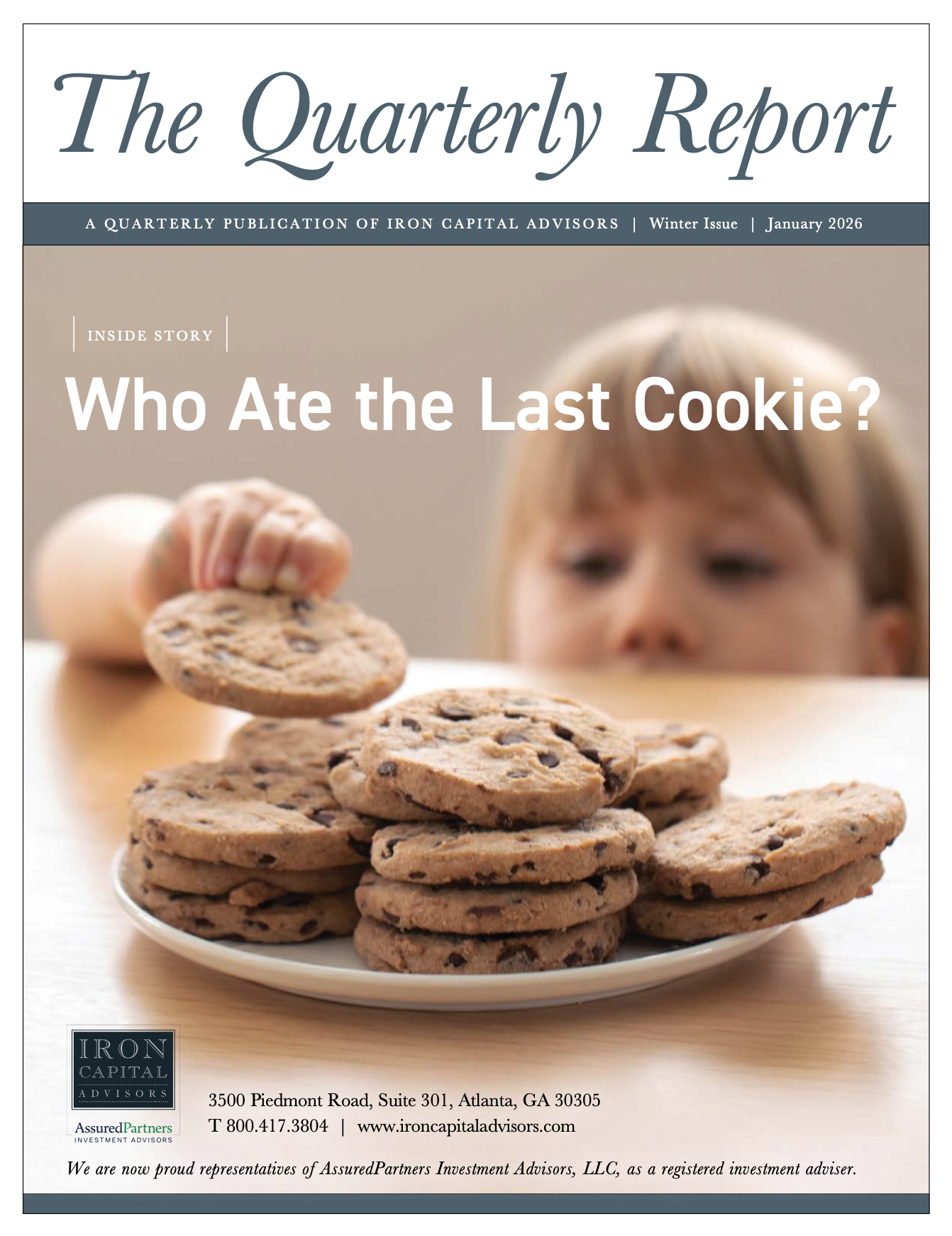
I don’t know if this is true in your house, but in mine, few things are quite as dangerous as eating the last cookie. Not only will the guilty party be scolded over his/her offense, but he/she also will be accused of eating “all of the cookies.” This is especially true this time of the…

We were in an outdoor café in downtown Warsaw. Invesco had entered into a joint venture with a French insurance company and the Polish Post Office as one of a small handful of western asset managers partnering with what seemed like unlikely local firms to give Polish citizens options for managing their government retirement benefits,…
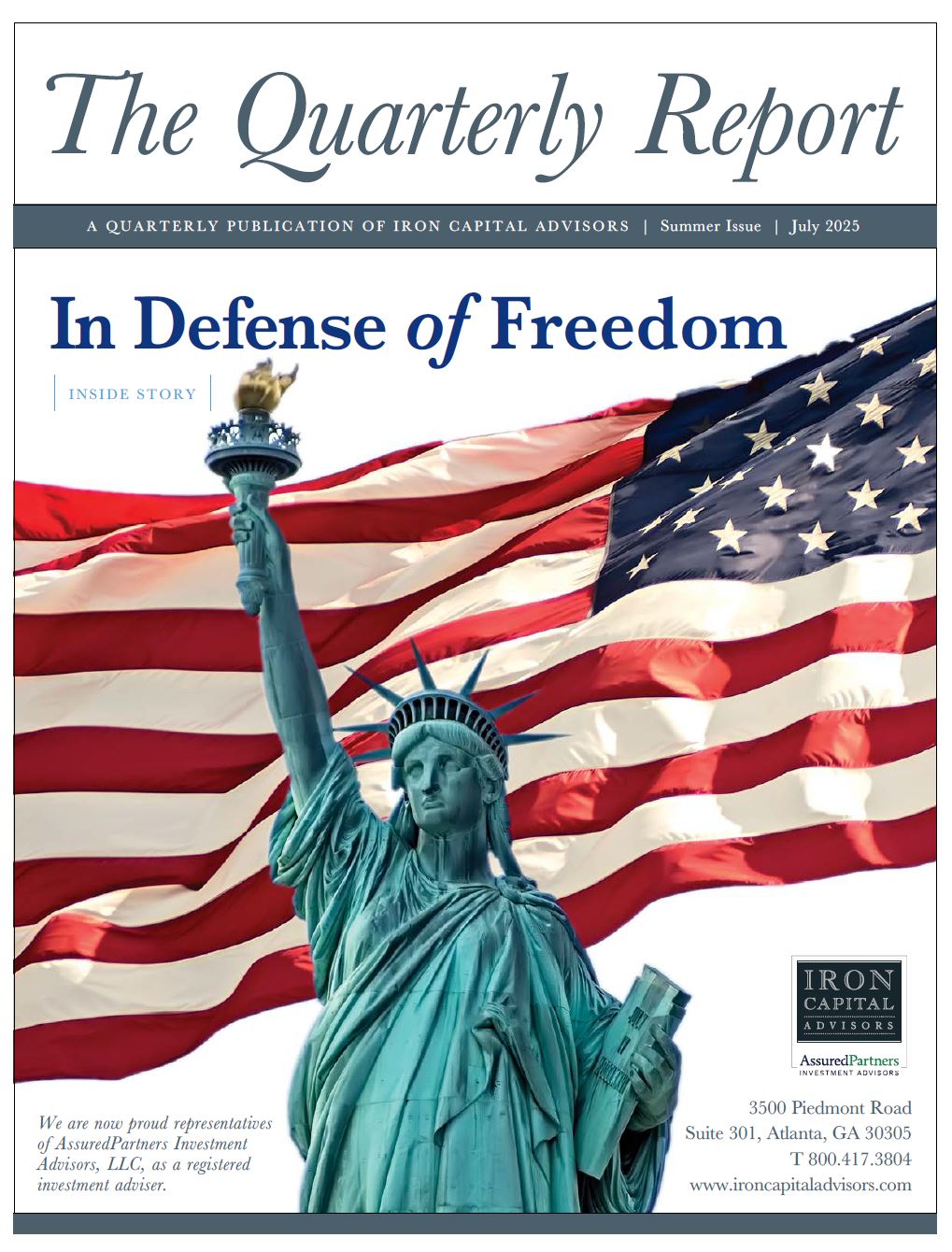
Capitalism isn’t perfect—but it’s better than the alternatives. Critics blame the free market for today’s problems, yet most issues stem from overregulation, not capitalism. Freedom works, even if it’s messy. As Churchill said of democracy, capitalism is the worst system—except for all the others.

Donald Trump has come back into office with an economic plan that is a three-legged stool. (We don’t discuss politics, but we do discuss economic policies that can impact your portfolios.) One leg of his plan is regulatory reform; the second is tax reform; and the third is his desire to have high tariffs to make it difficult for Americans to buy goods from international companies. The biggest change is in the size of his ambitions and the order in which he has decided to tackle his priorities.

The market has been flip-flopping for a while now, and while most seem not to notice, I am really getting tired of it. If one pays attention only to the S&P 500 index, then it may not seem like there is any inconsistency. This index, which many use as that proxy for the market, just keeps going up quarter after quarter, or at least it has over the last couple years. However, as I have said more times than I can count, it is what happens underneath the surface that really tells an investor what is happening.
I don’t know if this is true in your house, but in mine, few things are quite as dangerous as eating the last cookie. Not only will the guilty party be scolded over his/her offense, but he/she also will be accused of eating “all of the cookies.” This is especially true this time of the year as the Christmas aftermath is slowly but surely consumed.
In our house we go much of the year without any cookies at all. Perhaps if there is a special occasion, there might be one batch of one type of cookie. Around mid-December, that all changes: We receive cookies as gifts; the children participate in cookie swaps; and of course, we feel obligated to make our own traditional favorites to celebrate Christmas. Most years the cookie supply peaks around December 23, at which point either my wife or I will usually make a comment about over-doing it and finally say, “We will never be able to eat all of these.”
At that moment, no one in the house cares who eats what cookie; the cookies have practically no value. No one is fighting over cookies or hiding cookies, as we are living in the land of cookie abundance. Then Christmas passes. We continue to indulge in cookies through the New Year holiday, and in early January, certain individuals begin to notice certain varieties getting low in supply. As this happens, behaviors start to change: Some cookies will suddenly “disappear” from the usual cookie location. Individuals will start declaring ownership of other cookies. Gifts that were addressed to the family suddenly become the possession of the person closest to the giver. Then, finally we are down to the last cookie. Woe unto thee who eats the last cookie. The last cookie is never eaten openly; it must be consumed in secrecy so that the guilty party may claim innocence. “What cookie? I thought those were gone days ago.”
What we witness every holiday season is a perfect example of the economic law of supply and demand. When cookies are in overabundance they have little value, but as the supply shrinks, the value of each cookie grows until we are down to only one.
One of my most frequent comments over the last several years has been that I no longer understand how they teach economics today. I started saying that roughly around the time when the Fed kept saying that inflation was “transitory.” I was an economics major in college, and I still think like an economist. More specifically, I think like a microeconomist. Microeconomics is the study of how individuals and individual businesses make decisions. It gives us the laws of economics – laws that are consistently observed in reality. Macroeconomics is the study of top-down national and global economies. It is more used in policy-making and is what most people think of when they think of economics; it is also what give economics a bad name.
I saw governments forcibly restricting supply while also attempting to stimulate demand. That is a recipe for inflation. It was so simple for anyone who had a passing grade in Microecon 101 that I could not understand how an institution like the Fed, which is largely staffed by individuals with PhDs in economics, could possibly misinterpret what was happening… which makes me wonder if microeconomics is even taught anymore.
Supply and demand are like lots of fundamentals, which we seem to have lost in our modern society. It is really a simple concept, but understanding it is incredibly useful because it explains so much of what happens in our world, both good and bad. Several years ago, I read an article about the teaching of phonics in California elementary schools. They had moved away from it and saw literacy rates go down, and so they brought it back. It worked and literacy rates rose, but the teachers hated it, because it was boring to teach such simple fundamentals. They killed it again, and literacy rates once again declined. Has the same happened in schools of economics?
The same thing certainly has happened in sports. Youth coaches used to understand that their job was to teach the basic fundamentals, but it is so much more fun for the coach if they skip straight to strategy. Simple fundamentals are boring, but they are also essential.
The price of everything is determined by the supply and the demand for that item. The “right” price is the price where supply and demand are in balance. If the demand for an item increases, then the price will increase, which then incentivizes suppliers to increase the supply. When the supply then outpaces demand, the prices will fall, which will stimulate more demand and incentivize suppliers to cut back. Ultimately a balance arrives where supply and demand match if given the freedom to do so.
I suspect that if you asked most people on the street if they understand supply and demand, they would say yes. I also suspect if you then asked them how a business could maximize its profit, they would say by raising prices…which is proof that they do not, in fact, understand supply and demand.
Let’s start a fictional manufacturing company that makes the almighty widget. The current price of the widget is $10, and we sell a million of them at this price for total revenue of $10 million. The cost of making widgets is $8 per widget, so we have a $2 million profit. Many believe we could increase our profit by increasing prices to $15. However, the increase in price will reduce the amount demanded. Now we only sell 600,000 for a revenue of $9 million. If we produce less then costs will also go down, but a good portion of the previous $8 per widget cost is fixed, so the cost per widget at the lower production level is $12.50. While our profit margin rises a little to $2.50 per widget vs. $2.00 per widget the total profit drops to $1.5 million.
On the other hand, if we lower the price to $8 then we could sell 1.5 million units, which would mean $12 million in revenue. The higher volume would reduce our cost per widget, but only to $7, which would lower our total profit to $1.5 million. So, in this fictional example, $10 is the “right” or equilibrium price.
The incentive of all business owners is to increase volume by reducing price and to use scale to reduce the cost of production per unit. This incentive is balanced by the fact that price alone does not determine demand;
Quality must be maintained, otherwise the widgets lose utility to the buyer and demand disappears completely.
This is how supply and demand work. So, will reducing tax rates actually increase tax revenue? Some will say yes while others argue of course not. The truth depends on where we are lowering from. As with everything, there is a balance. Taxes are the price of profitable economic activity; if that price is too high, then people will reduce economic activity and less tax revenue may be the result. It is also true that there is a limit to lowering rates, which we explained in detail in our third quarter 2010 issue of The Quarterly Report, “A Taxing Debate.”Neither political party seems to understand this simple truth.
The lack of understanding of simple supply and demand also explains the failures of the Affordable Care Act. To balance supply and demand, the price must be known. The Affordable Care Act does not do anything to reduce costs in our healthcare system; if anything, it does the opposite. It produced a wave of healthcare professionals who have left the traditional healthcare world by either retiring, or by starting so-called concierge doctors’ groups. Then it subsidizes the cost to keep the price artificially low. Now it is easier to be insured, but harder to actually see your doctor; it reduces supply while simultaneously stimulating demand through subsidies. This occurred because it focused largely on the cost of insurance, which was a symptom, while not focusing on the actual cost of healthcare, which was the disease.
The same Fed PhDs who missed inflation a few years ago do not understand that tariffs are not going to cause inflation today. Prices are set by supply and demand. While finding the equilibrium price takes some experimentation, a well-run business figures it out pretty quickly. That price has little to do with their cost. Tariffs raise the cost of doing business, which makes the business less viable. Tariffs reduce economic activity and if they are bad enough, which they were in 1930 but have not been thus far this time, they cause depression and deflation.
Today the same mistake is being made in New York City with its real estate affordability issue. If affordability is an issue, that means the supply of whatever item we are discussing has been suppressed. If we want to make apartments in New York more affordable, then we must find ways to increase the supply of apartments. Rent controls do the opposite; they provide a disincentive to increase the supply, as do zoning regulations, building codes etc. They increase the cost, which reduces the viability of building new apartments. Please don’t misunderstand – we may decide that certain zoning rules are desirable and building codes absolutely necessary, but we also have to understand that they come with a cost.
The search for the equilibrium of supply and demand is full of tradeoffs; the reality of supply and demand forces us to face those tradeoffs and deal with them as mature adults. We have to make the hard choices. Even if the local authorities in New York City do everything right, the city will still be a very expensive place to live. There are millions of people, which means demand is very high, and it is made up of islands, which means the supply of land is not going to increase.
That may be unpopular to hear, but it is the truth. Apartments will always be more affordable in my home town of Atlanta; we have far fewer people, and there are no natural barriers to expansion. This brings about other issues because there are always tradeoffs; the traffic in Atlanta is horrible. A simple understanding of supply and demand does not solve every issue, but it does help crystallize the question at hand.
This mindset helps immensely in investing. The new year marked the end of Warren Buffett’s famous career as he retired at age 95. One of his investing principles was to invest in companies that had competitive moats, which restrict the number of competitors and therefore the supply of their product. These moats boost these businesses in the same way that the Hudson River boosts New York real estate prices. Supply is the key.
If we want a more affordable world, then we need to stimulate the supply of things we need and want. We need housing, education, and healthcare to be as readily available as cookies on Christmas Eve. Until we learn that lesson once again, we will continue to have the high cost of limited supply, which only leads to the blame game. Who ate the last cookie? Was it you?
Warm regards,

Chuck Osborne, CFA
~Who Ate The Last Cookie?
We were in an outdoor café in downtown Warsaw. Invesco had entered into a joint venture with a French insurance company and the Polish Post Office as one of a small handful of western asset managers partnering with what seemed like unlikely local firms to give Polish citizens options for managing their government retirement benefits, similar to our Social Security. (Yes, there is some irony that a former communist country had no issue privatizing their program while the U.S. never could, but that is another story.)
Sitting in that café, my two French colleagues and I were in complete agreement: Warsaw was a much better city than we had ever imagined. Before changing your European tour itinerary, let me be clear – we all agreed that in this case, low expectations helped. We had all been overly pessimistic about what we would find in this formerly communist city.
In investing, as with travel, low expectations can be a good thing. Look back at 2023 and 2024, when most of Wall Street kept saying that recession was right around the corner. The so-called yield curve had inverted, and groupthink said that must mean recession. For those who speak English and not invest-speak, the yield curve is the line that forms when one plots the various interest rates of U.S. Treasury obligations of different maturities.
Quick reminder: bonds are simple loans, so when the government borrows money, it issues bonds. Government bonds are like other loans in that they can be for differing periods of time. A credit card allows a responsible user to borrow money today and pay it back at zero interest when the bill comes next month, or not pay it back and pay outrageous interest. A car loan is traditionally for five years or less, although they are getting longer as car prices increase. A mortgage can be for 15 or 30 years. Similarly, the government borrows for different amounts of time ranging from 90 days to 30 years. All else being equal, the longer an investor has to wait to get her money back, the higher interest rate she will demand. This means the “normal” yield curve slopes up and to the right. The rate on 10-year bonds will be higher than the rate of 5-year bonds, which are higher than 2-year bonds, etc.
While this relationship generally holds, there are times when it doesn’t, and the post Covid world has been one of those times. When the longer termed bonds have lower interest rates than shorter term bonds, we say the yield curve has inverted. Historically this has often signaled a recession, but that did not hold up this time around, much to the embarrassment of many pundits. Too many got fixated on this one indicator and refused to see the rest of the positive picture.
Pessimism can be blinding, and it is an easy thing to fall into. I have been writing these Quarterly Reports for more than 20 years now and one of my favorites from early on referenced the movie “Men in Black.” To quote Agent K (Tommy Lee Jones), “There’s always an Arquillian Battle Cruiser, or a Corillian Death Ray, or an intergalactic plague that is about to wipe out all life on this miserable little planet…”. I don’t know if any of that is factual, but Agent K has a good point: There is always something – a geopolitical issue, high valuations, uncontrollable government debt, and yes, as we have witnessed, even a plague – ready to wipe out our 401(k)s.
Fear sells, and there are plenty of people willing to take advantage of that opportunity. One need to look no further than cable news and social media. My colleague Michael Smith often says that Bears (to use the market-based pessimism) always sound smarter than Bulls. He, too, has a point: Today, Bears can talk about wars in Eastern Europe and the Middle East; runaway government debt throughout the developed world; sky-high market valuations; a weakening labor market; stubborn inflation; government shutdowns; and so on. So many Carillion Death Rays aimed right at this miserable little planet, woe is us.
One can grab any one of those topics and spin a tale of doom and gloom about the stock market and even the future of the United States or all of Western Civilization, for that matter. He can make it sound deep and well-conceived. On the other hand, the bullish positive message just sounds naïve: “It will all be okay, guys.” That just doesn’t resonate against all of the pessimism, which is unfortunate, because while the future is always uncertain, “it will all be okay” is the most probable outcome.
This is why we so often talk about prudent investing being done from the bottom-up. It is far easier to analyze a specific company and make the determination for whether to invest in its stock than it is to try to figure out what will happen in Ukraine, how that will impact global natural gas prices, and how much of an input is natural gas to income statements of the S&P 500 companies? That rabbit hole is intellectually gratifying as we love to make connections and show off how many levels of reason we can spiral, but will it actually provide investable insight? Doubtful.
So how do we deal with all the potential negatives? Prudent investing is also risk-averse. Our industry has defined risk as volatility, but this is problematic: Volatility goes in both directions, and investors tend not to be concerned with upside volatility. Volatility is also backwards-looking. The mortgage-backed securities that nearly destroyed the world in the 2008 Great Recession had almost no volatility until they blew up. The most volatile stocks often deliver the highest returns, hence the relationship between risk and reward. We like the old idea of risk, which Benjamin Graham referred to as the Margin of Safety. Price relative to value is, in our opinion, the best measure of risk. When the calculatable value of a company is significantly above the price of its stock, then there is a high margin of safety; if it is the other way around, then risk is real.
The obvious question is: If this is how we see the world, then how could we not be disturbed by the market being at record highs? Because that isn’t a real measure. “Record highs” looks only at price and does not involve value. Also, the market is supposed to be at all-time highs; that is like saying my 15-year-old daughter is at her all-time high height. Children grow, that is what they do. If she were not at her all-time high height, we would be taking her to the doctor to figure out what is wrong. While markets don’t grow in straight lines like children, they do grow over time so being at an all time high is normal.
This is also problematic because it is a top-down view of the whole market, however one wishes to define that term, and the better view is from the bottom-up. There are plenty of companies that are not at all-time highs. One example would be Duolingo, a company that provides a language learning app. This stock is down 0.74 percent year-to-date through September, while its earnings per share are up 71.43 percent over the last twelve months. This is just for educational purposes and not a recommendation, but this one example has grown as a business while its stock price has dropped. So, it is not at “all-time highs.” There are plenty of other examples.
Pfizer’s stock price is more than 25 percent below where it was three years ago. It’s price-to-earnings ratio is just 8.59 based on next year’s estimated earnings, while it is 14 times the actual earnings from the last twelve months. So, when people fret about all-time highs and how incredibly expensive the stock market is, they are clearly not talking about Pfizer. These examples are just to show that what is happening below the surface of the market is not always in line with the narrative of the day. The S&P 500 index is at all-time highs and very expensive from a historical basis, but that is skewed by some very large outliers. There are lots of stocks that do not fit that description.
Being optimistic in the face of market pessimism is often very fruitful. As the old adage goes, we want to buy when others are selling and sell when others are buying. However, pessimism is going deeper: According to a joint poll by The Wall Street Journal and the National Opinion Research Center (NORC), nearly 70 percent of people said they believe the American dream – that if you work hard, you will get ahead – no longer holds true or never did, the highest level in nearly 15 years of surveys.
This is truly frightening. One of the secrets to America’s success is that we are a relentlessly optimistic people. We believe the future will be better, and that is important because in many ways this is a self-fulfilling prophesy. As Henry Ford once said, “Whether you think you can or think you can’t, you are right.”
The WSJ-NORC poll did show a small uptick in people believing the economy was good, but in the September 1 article, they followed that insight with this excerpt: “And yet many people in the survey, as well as in interviews, said they felt a sense of economic fragility, even if their finances were adequate or secure today. In a generational cascade, majorities said the prior generation had an easier time buying a home, starting a business, or being a full-time parent rather than in the workforce, while majorities also said they lacked confidence that the next generation could buy a home or save adequately for retirement.”
Home ownership has been such a central part of the “American dream,” and there certainly are issues today. The main problem with housing today is lack of supply, and especially the supply of starter homes. There are multiple factors here but one of the largest is runaway regulation. A few years ago, California mandated that all new houses had to have solar panels. Whether or not one believes this is a good idea, there is no question that it raises the cost of building homes. Solar panels for a house are not cheap. These types of rules make what is already hard seem impossible.
The ability to start a business is directly related to the level of regulation in the particular business. In the early 1980s, a few years after my father moved us from our North Carolina home to South Florida, Dad had the great idea of introducing Floridians to North Carolina barbeque. Today everyone knows of North Carolina barbeque, but that was not the case 40 years ago. When my father proposed the idea to the Stamey family, owners of Stamey’s BBQ in Greensboro, NC, they quickly told him that it couldn’t be
done. The Florida environmental regulations would not allow for all that hickory smoke to go into the atmosphere. Since then, there have been 40+ years of regulation piled on top of what existed then. Some of it may be good, some bad, but all of it makes it more difficult to start a business.
We need to get back some of that American optimism. To fix the real problems in our system we will need some thoughtful regulatory reform; Meanwhile, we can focus on what we can control. From an investing standpoint, low expectations can be a good thing. It’s boring and it doesn’t sound nearly as intelligent as a complex conspiracy of our ultimate doom, but if we prudently invest from the bottom up and manage our risk, things really will be okay, guys.
Warm regards,

Chuck Osborne, CFA Managing Director
~Pessimism Abounds
“Give me liberty or give me death!” ~ Patrick Henry
One of my aunts used to say we were related to Patrick Henry. I was never sure if she meant our family or my uncle’s family, but as a kid I thought it was cool. Who wouldn’t want to be related to that brave patriot? Liberty is America’s defining virtue, not just Henry’s. Our well-known inalienable rights are life – the essential freedom to live as we wish; liberty – freedom itself; and (in case you didn’t see this coming) the pursuit of happiness – the freedom to pursue our dreams. America is not just a place, it is an idea, the home of the free and the land of the brave. In this way we are all related to Henry.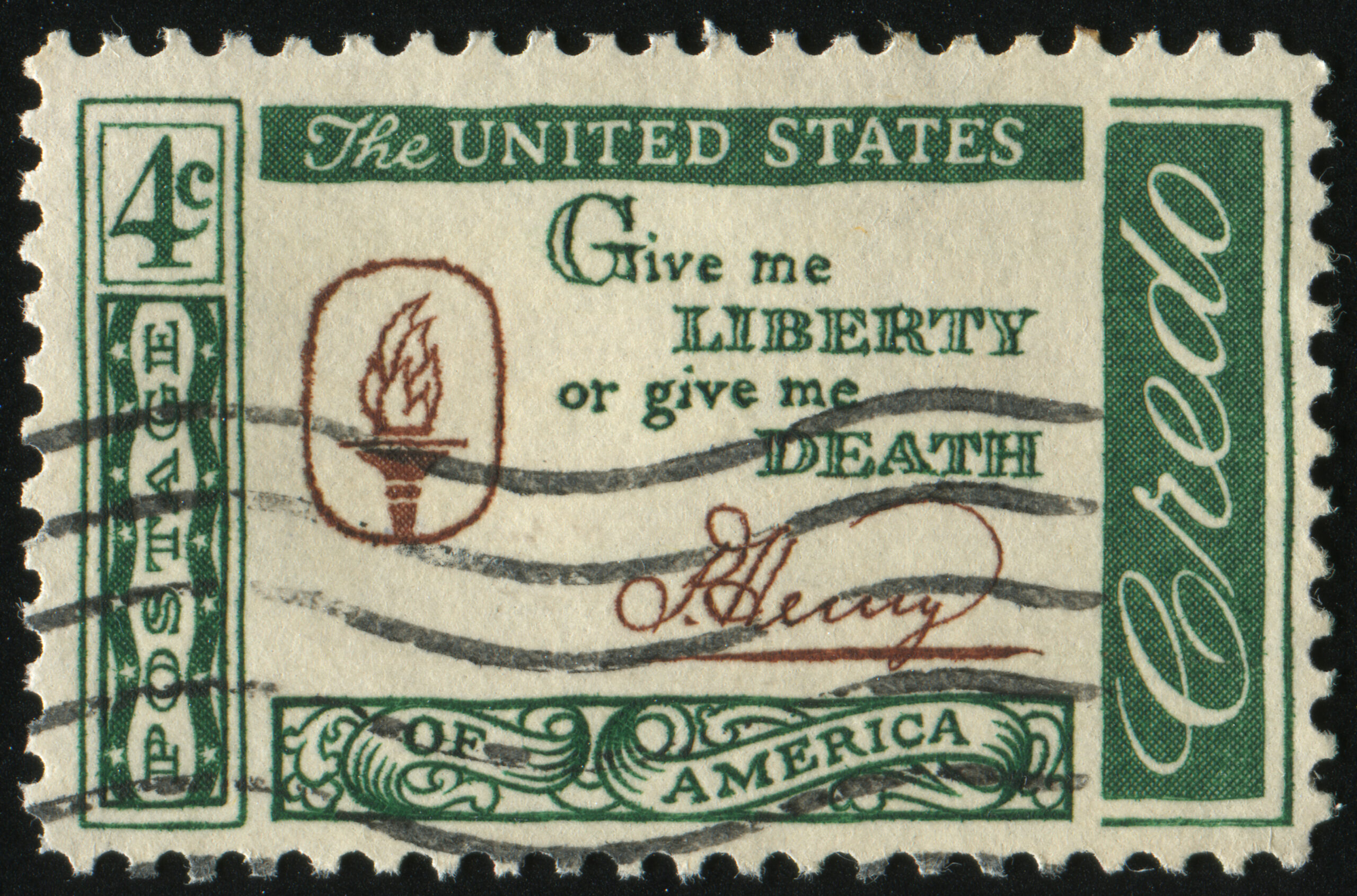
Freedom, however, is under attack from seemingly all directions today. Voters in New York just selected a socialist in the democratic primary. Vice president JD Vance recently admonished conservatives who he claims, “worship the capital M market.” Milton Friedman famously observed that, “Underlying most arguments against the free market is a lack of belief in freedom itself.” This still holds true, but today there is another element from those who lack understanding of what the term “free market” means.
The confusion is understandable as we are constantly surrounded by references to the stock market. Following the stock market is my job, but even if it were not, one cannot escape daily reminders of what happens in the stock market. Every time there is some scandal or a crisis, people are reminded of the unlikability of Wall Street and all that goes with it. I believe many confuse a “market economy” with the stock market, and they are not completely wrong. The free flow of capital, through a stock market, is certainly an attribute of a market economy, but that is not the complete story.
The term “market” in market economy is just the term that economists use to describe the aggregate of every individual economic decision every individual in a free society makes. When a child sets up a lemonade stand, that is the market. It is free because no one has to buy the lemonade, and no one forced the child to sell lemonade; everyone at the lemonade stand is acting of their own free will. The lemonade stand is the purest form of capitalism. There are no regulations, no taxes, just an innocent child setting up a simple business and thirsty neighbors willing to pay for what is usually some pretty bad lemonade. The neighbors get to quench their thirst and feel good about supporting a young entrepreneur, and the child gets a little financial boost and some great life lessons. This is a win-win situation; there are no losers at the lemonade stand. That is capitalism.
For most of my adult life we all understood this. Any time someone tried to attack capitalism, all one had to do was point to the collapse of the Soviet Union and the success of the Reagan / Thatcher reforms in the U.S. and U.K. One did not have to be an economic scholar to see the obvious contrast: Total collapse versus huge success, this wasn’t nuance. Most people, especially in the investment world in which I live, thought this conversation – which had taken up so much oxygen in the 20th century – was over.
That changed with the financial crisis in 2008: Those bank failures magically resurrected the anti-capitalism crowd. The actual crisis was caused, as all true crises are, by a confluence of simultaneous factors, but the long-lost big government/anti-capitalism crowd had a very simple one-word explanation for the whole thing: greed. Capitalistic greed caused the crisis, they said. That explanation sold because it was simple, and it easily identified a culprit: greedy Wall Street bankers. Of course, the idea that greed explained the crisis was and remains absolutely absurd. We wrote about this at the time. There are so many holes in that argument that one could not possibly count them all, but primarily for this argument to work it would mean that greed was somehow new. People have always been greedy, yet we do not live in a constant state of financial crisis. Milton Friedman said it best when he said, “Of course it is always the other guy who is greedy, we are never greedy.”
Wall Street helped the simpletons’ cause by providing anecdotal stories of incredibly greedy, and frankly often stupid, bankers. I have been in this business a long time, and most people in it do not fit that description, but those who do are ever-present. They contribute to every crisis, but they do not explain a crisis. Let me be clear: this does not excuse the mortgage banking industry or the Wall Street bankers who financed the industry. They certainly deserve their portion of the blame.
However, the crime in that explanation was that it completely exonerated a group that deserves at least an equal portion of the blame: government politicians and regulators. The oft-used quote of the “blame capitalism” crowd was that the crisis was caused by the “unregulated banking industry.” I suppose that I should have known then that the post-modernist idea of truth being whatever you feel it is had taken over our discourse. If there is an industry more regulated than the financial industry, I would like to see it. Yet, I had college-educated people who had purchased multiple homes over the course of their lives look at me in all seriousness and claim that the mortgage industry was unregulated. I would ask them, “Was there a lawyer at your closing? How many disclosures and documents did you have to sign?” That is regulation. The OCC, SEC, FDIC, Federal Reserve, and various state agencies all regulate financial firms and have since at least the 1930s.
Today we hear the line that “the free-market economy is not working for everyday people.” We hear this from both the left and the right. However, every single example they give is, without fail, a place where regulation has replaced the free market. To say that the United States is a capitalistic country is mostly correct, but it is not absolutely correct. In reality, all countries exist on a spectrum. The extremes would be a truly free market with no rules on one end, and a complete command economy with government running every single decision on the other. No country can exist on either one of those extremes, but history has shown us that the closer we get to freedom, the better it is for everyone in a country.
So, what parts of our system are not working for people today? In New York one of the big issues is housing and the lack of affordable options. What caused the lack of housing in New York? Rent controls, for starters. When the there are limits on what can be charged, then there will be limits on how many units can be built. Add to that the high cost of construction. Zoning laws, environmental regulations, safety codes, and labor laws all add cost. This is not to say that some of these items, and maybe all, are not worth it, but there is no free lunch. Everything in life is a tradeoff. Every regulation that goes into the construction of an apartment building adds cost. When all these costs add up, but the price that can be charged is limited, then you will have a shortage. To the extent that property owners are willing, or forced, to rent apartments for less than their cost, then that difference has to be made up for elsewhere. One gets a poor mix of rent control and high-end luxury with nothing in between.
As Ronald Bailey points out in “The End of Doom,” shortages do not occur naturally. Free people find a way to balance supply with demand; this is the essence of economics. Shortages exist only when some outside force, usually government, interferes. Rent controls cause a shortage of affordable apartments. The knee-jerk reaction is more rent control, which will lead to even worst situation, which will lead to even more control, and down the road we go. This is the road to serfdom that Friedrich Hayek mentioned in his book of the same name. What else isn’t working? Healthcare and education costs are often brought up as examples, especially for many young people who are riddled with college loans. These are, of course, two places in our system where we see the highest levels of government intervention. On that spectrum between freedom and command, the closer we get to command, the worse everything gets. Yet, the knee-jerk reaction is always that more control is needed.
Still not convinced? Well, what is working in our society? We have trouble getting healthcare, but even the least fortunate today walk around with an item we refer to as a phone, but in reality it holds more computing power than NASA possessed when they first sent an astronaut to the moon. Technology is probably the freest segment of our society, and the cost continually goes down while access is always improving. Sure, there are issues here as well – privacy concerns, unintended consequences of social media, etc. There is always a balance to strike, but the closer we get to freedom – people freely choosing to do what they will – the better systems work. This may be counterintuitive, but history is crystal clear on this point.
So why do we seem incapable of remembering this lesson? It is in our nature to want to control things. This is a major theme of all religions and every lasting philosophy. Free markets are the best economic path, but there it no perfect path. Sometimes people will fall on hard times.
A free world can be a cruel world, there is no doubt. I wish everyone who claims to support the ideas of economists like Friedman and Hayek actually read their work. Both Friedman and Hayek argue for the necessity of a social safety net provided by government. They also pointed out potential pitfalls and certainly criticized specific programs, but both believed that a safety net was absolutely needed in any civilized society.
Freedom works. Why is this so hard for us to understand? Yet capitalism and its political partner, democracy, will always have their critics. I think Winston Churchill said it best when he said, “Many forms of government have been tried, and will be tried, in this world of sin and woe. No one pretends that democracy is perfect or all-wise. Indeed, it has been said that democracy is the worst form of government, except for all those other forms that have been tried from time to time…”. The same can be said of capitalism. It’s the worst form of economics, except for all those other forms that have been tried from time to time. Behind all the arguments against the free market is a lack of faith in freedom itself.
Patrick Henry was calling his fellow citizens to war. He was willing to fight and die, if necessary, to gain liberty. We have enjoyed that freedom for 249 years. It obviously runs through everything we do as investors, but it is so much larger than that. We need to counter those who argue against it. Freedom needs defending.
Warm regards,
Chuck Osborne, CFA
~In Defense of Freedom
I was 20 miles offshore, sailing north from St. Simons Island, Ga., headed to Charleston, S.C. The forecast was for strong winds so I had already reduced sail before the sun went down, but the forecasted wind had not showed up. I was beginning to question my decision to be so conservative when, at 12:30 a.m. off the coast of Savannah, Ga., the wind came. It seemed as if someone upstairs suddenly remembered they were supposed to turn the wind on, and they flipped the switch. In an instant we went from a light breeze to more than 30 knots of wind, and I quickly realized that I had not reduced sail enough.
The process a sailor goes through to reduce sail is called reefing. Every boat is rigged a little bit differently but the one thing they have in common is that there is a detailed step-by- step process for putting a reef in the sail, which makes the sail smaller and helps control the boat. On this boat the first step is to turn into the wind to reduce the pressure on the sail, then ease off of the various control lines to allow the sail to be lowered to the appropriate point. Once reefed, the control lines must be re-tightened, and then the boat can be turned back on course. Do those steps in order in a controlled manner and within a few short minutes you will have the boat back in control with more comfort and safety; but do any one of those steps out of order and total chaos will ensue. The order of operations matters.
Donald Trump has come back into office with an economic plan that is a three-legged stool. As always, we don’t discuss politics, but we do discuss economic policies that can impact your portfolio, so let’s take a look. One leg of his plan is regulatory reform, trying to make is easier to start and run a business in the U.S. The second leg is tax reform, really making his previous reforms permanent with perhaps a few other areas of tax relief. The third and final leg is his desire to have high tariffs to make it difficult for Americans to buy goods from international companies, which he believes will stimulate more domestic production.
Let’s break those down. The regulatory reform is the one that gets me excited. This is often a tough issue because it is nuanced, and we don’t do nuance well in our modern society. The opponents of deregulation build straw man arguments about there being no rules. No one wants to live in a society with no rules, but there is something called too many rules. One problem we have in America is that we are continually making new rules and seldom (if ever) getting rid of old rules. The labyrinth of red tape makes it very difficult for people to start new businesses.
Over-regulation also leads to what economists call rent seeking. Wealthy corporations can lobby the government to enact rules that benefit them and make it harder for small companies to compete. As Milton Friedman noted in his 1962 classic, “Capitalism and Freedom,” there is a direct correlation between the amount of regulation is a society and the amount of inequality. In my opinion, the economic community unfortunately has not done enough work on regulation, because it is difficult to quantify the impact of rules.
In The Bible, God gave Moses 10 rules. The United States Code of Federal Regulations (CFR) contains more than 186,000 pages of rules. Maybe 10 is too few for our modern world, but certainly there is a number between 10 and 186,000 that would make for a clearer, fairer system.
Tax reform, especially corporate tax reform, was desperately needed when Trump was first elected in 2016. The United States had the highest corporate tax rate in the developed world, which made it hard for smaller companies in particular to compete with large corporations that could lobby for loopholes. That is historically the biggest issue with high tax rates: The rich, who are supposedly the target of high rates, use their connections to get loopholes…so it is the small companies that end up being hit by the high corporate tax, which reduces growth and makes it harder for them to compete. Corporate taxes also are a tax on employees. There have been many studies to show that companies simply reduce wages to pay for corporate taxes; when the tax is reduced, wages rise. This occurred during the first Trump administration when, for the first time since the 1980s and 1990s, the bulk of economic growth actually went to the middle class.
On the personal income tax side, the need for reform was much less when Trump took office in 2016 and his cuts were far less effective. His new ideas of no tax on tips and no tax on social security will certainly benefit specific people, but that is not the best way to structure a tax system. The ideal would be to have a fair system where everyone would “pay their fair share,” no more and no less. That means having a low overall rate with few, if any, loopholes.
This brings us to the third leg: Tariffs. I struggle to understand why Trump believes this is a good idea. It is inconsistent with his other two priorities, which are clearly designed to reduce government’s impact in our daily lives. Tariffs are big government at its worst, protecting favored industries while hurting the masses with higher costs and/or little to no access to desired products or services. We have written about and discussed this subject quite a bit and will continue to do so as necessary. Bottom line for our purpose here is that tariffs are a tax on U.S. consumers and will slow economic growth.
In his first administration, Trump led with tax reform. House Speaker Paul Ryan had already designed a Republican blueprint for tax reform, so it was relatively easy to get passed. This stimulated the economy. Many of America’s largest multi-national corporations had been keeping cash overseas because of the existing corporate tax system, and that influx of capital in particular jump-started great growth.
Next came the regulatory reform. In true Trump fashion he made a theatrical presentation of cutting the red tape. More substantively, the administration came up with a brilliant plan: For every new regulation, the government identified two older regulations that had to be removed. This kind of strategy makes enormous sense. Rules become outdated; we all intuitively understand this. We see examples of local ordinances still on the books regarding where one is allowed to tie up his horses downtown; there are plenty of old rules which could probably go away. I also have firsthand business experience dealing with rules that contradict one another. Modernizing while also streamlining the United States regulatory framework is the best way to cut down on those 186,000 pages while maintaining the rules we still need.
Combined these two initiatives brought us what most remember as “the Trump economy.” Growth went up dramatically, the stock market soared, and all was good in the world. GDP growth went from 1.5 percent to 2.9 percent. Then, Trump declared his war on trade. GDP growth in 2019, before Covid, came back down to 2.3 percent. People forget that initial drop, because Covid hit shortly thereafter and drowned out everything. However, it was clear at the time that Trump’s agenda had led to two big steps forward and one leap back.
This brings us to Trump 2.0. He campaigned largely on a return to his three-legged economic plan. However, this time there was far more emphasis on enacting trade barriers. There were also more targeted political promises. The no tax on tips, for example, will certainly help some, but it is not the well-balanced reform plan that would benefit all. He also unleased DOGE, which helped reduce the size of government, but to benefit the economy that needs to be accompanied by actual regulatory reform to reduce the intrusion of government into our daily lives.
The biggest change, however, is in the size of his ambitions and, more importantly, the order in which he has decided to tackle his priorities. This time he has led with tariffs, including an inconsistent message regarding their purpose. Many in his administration have suggested that this is a negotiation tactic to get better trade deals, yet Trump himself seems to suggest that the tariffs are permanent. He launched them all at once and with amounts much higher than anyone expected based on conversations with the administration.
This has caused turmoil in financial markets and a dramatic slowing of economic growth. The Atlanta Fed’s GDPNow measure is showing a negative growth rate in the 2025 first quarter GDP. The model, as of April 3, is indicating a drop of 2.8 percent. This has been exacerbated by imports of gold that are not in the actual GDP formula, so when adjusting for that, the measure shows a drop of 0.8 percent. Considering that Trump inherited an economy which was growing at 2.8 percent in 2024 that is a lot of damage in a short period of time.
Unlike the two steps forward and one step back of his first administration, this time Trump has started with the step backwards. There are many who believe this is on purpose; they point to the Reagan years, which began with a recession but ended with what was at the time the longest economic expansion in U.S. history. The belief is there will be short-term pain but long-term gain.
This could happen, assuming Trump follows through with his other two economic initiatives. Regulatory and tax reform will help stimulate growth and could come to the rescue. There will also be trade deals done, and it would be very surprising if these tariffs are not challenged in court.
The Constitution gives Congress the power to issue tariffs, not the president. While more and more of the authority of Congress has been transitioned to the executive branch, there are limits which Trump is certainly pushing. In fairness, Biden also pushed the limits with his student debt forgiveness, which the courts stopped.
This leads to another matter. Because all of this is being done by executive order, the next person in the White House could just reverse course. The long success of the United States and our system is largely driven by the slow mechanisms of the balance of power and the need to rule by consensus and get things done in Congress. This has kept us from bouncing back and forth from extremes based solely on who won the last presidential election. If Trump wishes to make a lasting change, then he needs to make Congress do its job and pass laws instead of just writing executive orders.
The order of operations and how things are done matters. Two steps forward and one step back feels much different than starting with one step back. Getting things through Congress as our system is designed may take a long time and require some compromise, but that has actually been the secret of our success as a country.
In the meantime, what are we to do as investors? Well, we must focus on what we can control. We have navigated rough spots before. When at sea it is best to try to avoid storms, but sometimes that is not possible. In those times, we just have to reduce sail and go through the storm. There is always a calm on the other end. We will make it through together.
Warm regards,
Chuck Osborne, CFA
~Order of Operation
We survived yet another election year. I don’t know about you, but I am glad not to see any more political advertisements, at least for a while. Politics is a full- contact sport and not for the faint of heart; mud-slinging both ways comes with the territory. Many sins no longer seem to even raise an eyebrow when in my youth they would have ended a politician’s career, but there is one political sin that still seems to stick: If you are interested in politics, then you best not get caught flip-flopping.
I’m not talking about my personal preference for footwear. I grew up in South Florida; who wants to wear shoes when it is always hot? No, I am talking about flip-flopping of political positions to go along with the preference of the day. The examples are too numerous to count, so much so that the “he was for it until he was against it” phrase is now a political cliché.
Politics is not the only place where flip-flopping takes place. The market has been flip-flopping for a while now, and while most seem not to notice, I am really getting tired of it. If one pays attention only to the S&P 500 index, then it may not seem like there is any inconsistency. This index, which many use as that proxy for the market, just keeps going up quarter after quarter, or at least it has over the last couple years. However, as I have said more times than I can count, it is what happens underneath the surface that really tells an investor what is happening.
After years of only a handful of technology companies accounting for the vast majority of gains, the market finally broadened out in the last quarter of 2023 and continued that trend in the first quarter of 2024. To break this down, let’s look at a better proxy for the entire stock market. Most institutional investors use the Russell indexes as their market proxy. Russell starts with a total market index, which is made up of 3000 of the largest companies whose stock is publicly traded. They break that down into large companies, represented by the largest 1000 of those companies, and small companies, represented by the remaining 2000. These are simply named the Russell 1000 and Russell 2000.
Russell then breaks down these indexes by investing style. There are two broad styles used to select stocks for investment: growth and value. The growth style is about investing in companies that are growing more rapidly than the market average. These investors tend to look for companies that are on the cutting edge and that have compelling stories about how their products will change the world. In theory, these investors will pay any price in order to be part of the cool crowd.
The alternative style would be value. Value investors are bargain shoppers. They have no problem wearing last year’s styles if it saves them a few dollars. They want to buy stocks when they are on sale. They tend to invest in older, more stable companies, and may even purchase shares when there is some bad news for the company that they view as temporary.
Institutional investors find this breakdown useful because we can then focus on large growth and value companies, and small growth and value companies. This helps us understand what parts of the market are working and what is not. In the first quarter of 2024, everything worked. Large growth was the best place to be with an 11.4 percent gain, but large value returned 9 percent and small companies were up nicely as well. We had a broad-based market rally.
Then the market flipped. In the second quarter of 2024, the big technology companies in the large growth category were the only stocks that worked. The S&P 500 index was up 4.28 percent that quarter, but when we broke the market down into size and style, large growth was up 8.3 percent and every other category actually lost money. The returns were once again concentrated all in one area.
Then the market flopped. In the third quarter of 2024, the S&P 500 was up 5.89 percent. When we look at the breakdown, small value stocks were the best place to be up 10.2 percent. Small growth stocks were up 8.4 percent and large value stocks were up 9.4 percent. Large growth stocks were still positive, up 3.2 percent, but they shared the glory with the rest of the market and were actually the worst place to be. Once again, we had a broad-based rally in the market.
Then the market flipped. In the final quarter of 2024, large growth finished up 7.07 percent while large value was down 1.98 percent. Small growth was barely positive, finishing up 1.70 percent, and small value finished down 1.06 percent. Here is where it gets really interesting: It looked nothing like that through the month of November. Through November small companies had been the best place to be while large companies were also up nicely, with growth and value within rounding error of each other. Then December hit and the entire market dropped 7 to 8 percent except for large growth, which was up just under a percent. The market didn’t just flip; it flipped out.
Why? To tell the truth I don’t really know, but I do have a theory. We will call it the double I theory. Investors are irrational idiots… just kidding. Investors fear inflation and interest rates. Through this period the 10-year Treasury rate climbed from 4.19 percent to 4.58 percent, accompanied by speculation about tariffs and deportations both causing inflationary pressures. These arguments suggest that tariffs will simply make prices go up, which is the very definition of inflation. The deportation argument is that deporting immigrants who are here illegally will cause a labor shortage, meaning companies will have to pay higher wages, which will lead to inflation.
Let’s take the tariff argument first. I have said repeatedly over the last several years that I do not know how economics is being taught today. I started that refrain when I read an article suggesting that most schools no longer teach price theory as part of the economics curriculum. If true, this means they are no longer teaching supply and demand, which would be a shame since that is one of the very few economic concepts that actually holds true in real life. Prices are determined by supply and demand. Contrary to popular belief, business owners cannot just raise prices whenever they want. This could be a newsletter unto itself, but for this conversation it suffices to understand that businesses cannot simply pass the tax along to the consumer and expect to sell the
same amount of goods. They will pass on what they can, and then eat the rest. They will then attempt to lower costs, primarily by cutting wages, and finally they will accept lower profits. Lower profits are a disincentive, so they will then produce less, at least for the U.S. market. This will cause both a reduction in demand and a reduction in supply. Consumers will also seek substitutes. We wrote in the past how high-fructose corn syrup became a replacement for sugar largely due to sugar tariffs. Those tariffs, which have been in place for decades, did not cause inflation (well, maybe waistline inflation, but not currency inflation).
Tariffs cause all sorts of economic problems, but the suggestion that they drive inflation is intellectually lazy. Tariffs were a significant contributor to the Great Depression and certainly one of the reasons it was a global event. An economic depression is associated with deflation, not inflation. Tariffs and trade wars cause a reduction in both supply and demand, which leads to deflationary pressures.
The deportation causing inflation idea is a bit of a stretch to begin with. There is very little evidence that wage growth leads to inflation, because wage growth is almost always associated with increased productivity. This argument also assumes that the vast majority of immigrants who are here illegally are gainfully employed in jobs that American citizens and immigrants who are here legally would not do for a similar wage. That is a lot of assumptions.
Time will tell what happens on this front. What we do know is that in prior periods when there has been a crackdown on immigration status, including a large number of deportations, it has not triggered inflation. We can look most recently at the Obama administration and their deportation efforts: We had plenty of economic issues in those years, not the least of which was the financial crisis they inherited, but inflation was nowhere to be found.
If I am correct about the lack of inflation triggers from these policies, then why did longer-term interest rates go up? Because the economy is growing at roughly 3 percent, and the belief is that the future will be even better. This should be a bullish phenomenon, not a scare; and that brings us back to our flip-flopping market.
The past 16 years have programed investors to believe that when the economy is bad, we should invest in large high-growth companies because these companies can grow earnings even if the economy as a whole is suffering. Older, more established companies and smaller companies are more dependent on a strong economy to help them grow. When the market broadens out, it reflects a belief that economic conditions will be good for the foreseeable future.
Will the market flop back to broadening out as we enter 2025? That is what should happen, and it should do so for two reasons. First, the market is expensive, and most of that high cost is reflected in the price of those large growth companies. The rest of the market isn’t exactly cheap, but the other areas are closer to average valuations, which should lead to better relative results. Secondly and probably more importantly, the economy is doing better than Wall Street wants to admit. Next year earnings estimate for the favored large companies is for 15 percent growth, while Wall Street believes that small companies will grow closer to 3 percent. The former may be a bit of a stretch, but the latter seems overly pessimistic.
All these factors point to the market broadening in 2025. Of course, the market can stay irrational for a long time. That is what keeps us on our toes. Regardless, at least we know there won’t be any political ads until 2026, and the only flip-flopping we will have to deal with will be in the markets and on the beach.
Warm regards,
Chuck Osborne, CFA
~Flip-Flop
