The stock market is filled with individuals who know the price of everything, but the value of nothing.
Philip Arthur Fisher

Our insights, reflections and musings on the most timely topics relevant to managing your investments.
Last week we received a surprisingly high first estimate of second-quarter GDP growth of 3 percent, which some touted as proof positive of the wonderful impact of tariff policy. Then we received a very poor jobs report, which others touted as proof positive that government data is rigged and can’t be trusted. How does the economy grow at 3 percent, yet create so few jobs?
The one thing that can be guaranteed in any financial plan is that the future will not be exactly as predicted. It may be close, but it could also be dramatically different. The one universal thing that every single financial plan needs is flexibility. Yet, it is hardly ever discussed. It is the missing ingredient.
If one of the most famous economists of all time could not profit from top-down economic forecasts, then how in the world could the average investor do any better? It is far easier to analyze a company and determine whether it is a good business worth investing in than to try to figure out what economic growth will be in a year and what that means for investing today. This may sound counter to what Wall Street says, but investors need to remember that Wall Street is in the transaction business.
One of the keys to a successful life is to keep one’s focus on what he or she can control. We cannot control what this administration does or the reaction of the masses that are wreaking havoc on the markets; We can control how we react, and in the long term, that will be the most important factor.
Will tariffs be the end of us? I am reminded of my college microeconomics professor, who liked to say that the economy was stronger than any government. I would add that both the economy and the market are stronger. Tariffs and the threat of tariffs have caused uncertainty, and contrary to the motto, they have actually put America last. On the surface it would seem that my good professor and I are wrong; however, one needs to look deeper.
In the past week I have seen two articles in The Wall Street Journal, one pro-tariff and one anti-tariff, which both ask a basic question: If tariffs are so bad, why have we not fallen into a recession?
Never mind that the rule-of-thumb definition of a recession has historically been “two quarters in a row of negative GDP growth,” and that the initial tariff announcements were made only one quarter ago, then delayed for 90 days. I realize that, in these days of our 24-hour news and social media noise storm, three months can seem like three years – but in reality, this past April was just a little more than 90 days ago.
Last week we received a surprisingly high first estimate of second-quarter GDP growth of 3 percent, which some touted as proof positive of the wonderful impact of tariff policy. Then we received a very poor jobs report, which others touted as proof positive that government data is rigged and can’t be trusted (except the GDP number we liked, of course).
There are plenty of people now explaining how government data is compiled: first releases are always estimates, and data continues to be collected. Revisions happen all the time, and in some cases, years later. What people are not talking about as much is important: How does the economy grow at 3 percent and yet create so few jobs?
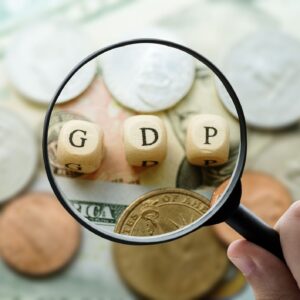
The answer to both comes with context, something we seem to lack the patience for these days. The economy growing at 3 percent was driven by an extremely low import number. The context here is that this 3 percent reading was preceded by a reading of negative 0.5 percent. In other words, when one simply looks at the data, then the economy shrunk by 0.5 percent in the first quarter, then grew by 3 percent in the second quarter. If all one did was average those two quarters, then he could see that growth in the first half of 2025 was an anemic 1.25 percent. That is not a recession, but it isn’t good either.
The wild swing in GDP is driven by international trade. Imports are subtracted from the math of the GDP calculations for reasons we have discussed before. There was an enormous influx of imports in the first quarter as many consumers and companies stocked up on international goods in fear of potential tariffs making them more expensive. There was then an enormous decline in imports the second quarter as those previously imported goods were used instead. Less discussed in the second quarter estimate has been the negative from a drawdown in inventories.
All of this simply leads to the conclusion that all data must be viewed in context and no single report tells the whole story. This is doubly true for the employment situation report. Even prior to the revisions, which have been attacked, the economy was on a downward trajectory in terms of new jobs being created. For most of my career, the thought has been that we needed the economy to add 200,000 jobs every month to keep the unemployment rate steady; this amount simply kept up with growth in population and turnover. In the last 24 months, the economy has added that many jobs only six times. Put differently, the economy failed to add 200,000 jobs in 18 of the last 24 months.
The economy is slowly losing steam, and we can kill the messenger if we wish, but that does not change reality. We are not in recession, but we are not growing fast enough to add sufficient jobs.
What does this mean for investors? The relationship between the stock market and the economy is loose at best. In the short run stocks move on headlines and emotions, and in the long run they reflect the earnings of the companies. While the economy has been slowing, corporate earnings are still growing nicely. It is too early this earnings season for any meaningful conclusions, but so far so good. AI is real and the demand for AI investment is just going to grow. It is already helping some companies grow productivity, which will help produce earnings growth even if revenues slow. We are cautiously optimistic, but more cautious than we were a few months ago.
It could all improve if the tariff situation settles down. It would not hurt for the Fed to lower rates (more to come on that), but in my view they are late to act. Meanwhile, we can avoid the madness by keeping reports in context, accepting reality for what it is even if we don’t like it, and focusing on what really matters, which are the companies we own and their actual businesses.
Warm regards,

Chuck Osborne. CFA
~Context Matters
“Security Analysis” by Benjamin Graham and David Dodd was published in 1934. It is the bible of investment management and, one could argue, of the entire field of what we now call analytics. Long before “Moneyball” introduced the idea of using quantitative analysis to manage a sports franchise, Graham and Dodd argued that analysis of data could lead to better investing outcomes.
Like the real Bible, far more people own “Security Analysis” than have read it. It is thicker than the real Bible and harder to read. I read it once, but I have also run a marathon, so I have the ability to endure long hours of pain. Most of the people I know in the investment world use it more as a reference guide. However, everyone in this business should read the first chapter. In this chapter Graham and Dodd tell their readers what is in store: They are going to go into incredible detail on how to analyze bonds, and if you have the endurance to get through this first half of the book, they will then tell you how to value a stock. They then let you in on a big secret, the one people who use the book only as a prop in their perfectly staged office don’t ever get: No matter the effort or detail of your models, or the rigor of your analysis, you are going to be wrong.
That’s right: The big secret from the greatest investing instructors of all time, Warren Buffett’s mentors, is that no amount of analysis will correctly project the future. So, why do it? Simple: One does not need to know exactly what a stock is worth. It suffices to know it is worth substantially more than it is selling for today. They called this the margin of safety. If one used the analytical tools spelled out on those pages to carefully value a stock at $100 and it was actually selling for $10, then that investor has a large margin of safety. It doesn’t really matter if the stock ever makes it to $100; if the analysis is sound, then there is a very high probability that it will be selling for more than $10 in the not-too-distant future. The smaller the difference between the estimated value and the current price, then the smaller the margin of safety and the less room for error.
This doesn’t just impact investing in a stock; it impacts any use of data to predict the future. The one thing any analyst knows for sure is that their models will never be exactly right. The future is always uncertain. Analysis can help to make better decisions, but it needs to be coupled with some humility. This is true when analyzing securities, the weather, or sports, and when constructing a financial plan.

Planning seems so concrete. We are going to retire at age 62 and have $X in our retirement account. We will have traditional retirement funds, and Roth funds, and we will take social security on X date. We are going to downsize our home to exactly X square feet, which will cost exactly X, and on we go. It is all so official and it is right there on the computer screen with all the very official looking graphs. Who could possibly argue? If you don’t believe me, search online and you will find lots of very confident planners telling you exactly what taxes will be when you retire and which strategy will work best.
Then something happens that’s not part of the plan. The government decides to replace all income taxes with tariffs. You put all your son’s savings into a 529 college plan and then he tells you that he is going to work on a yacht and sail around the world. You plan on retiring at normal retirement age and then one day you wake up and just say no, I’m doing it now. You plan a wonderful retirement with your life partner and then when the work stops you both realize that you have drifted apart and now wish to go your separate ways. You are in your peak income years, working hard for your well-spelled-out goals when your spouse is diagnosed with a rare disorder and gone in a matter of months.
Those are not random examples, but real situations that have happened to clients and friends over the last several months. I got the idea to write about this from another real conversation. A friend, who is not a client, wanted me to explain how she could put money into a Roth IRA even though she didn’t qualify to do so because her income is too high. I asked her why she was trying to put money into a Roth, and she replied that she maxed out her retirement plan at work but still had money to invest.
It never dawned on her that she could simply put that additional money in a brokerage account. The financial services industry has become so product focused and has marketed this message so effectively that people forget that in the end it is about saving enough money. It isn’t about having the right types of accounts; it is about having the right amount of money.
I hear the objections now. What about taxes? Yes, we want to be tax efficient, but not paying taxes is not a good goal. If one really wants to avoid taxes, then she should simply go broke. If she gets broke enough, the government will give her money. Is that really what we are after?
Besides, there is hardly anything as tax efficient as good old-fashioned stock investing. The investor invests with after-tax money and does not pay taxes until a gain is realized by selling the stock. If the stock goes down in value, the loss can be realized and offset other income. Long-term gains are taxed at capital gains rates and not income rates. So, the marginal tax benefits of a Roth are not nearly as great as touted.
However, even if those tax benefits were tremendous, there is a giant cost that no one talks about: The loss of flexibility. The one thing that can be guaranteed in any financial plan is that the future will not be exactly as predicted. It may be close, but it could also be dramatically different. The one universal thing that every single financial plan needs is flexibility. Yet, it is hardly ever discussed. It is the missing ingredient.
IRAs, Roth IRAs, 529s – they all have their places, but don’t get so caught up in the product that you forget the simple brokerage account. It can be more tax efficient than most people realize and more importantly, the money in it can be used for whatever, whenever. Planning is a good thing, but don’t forget that life happens, and your plans need to include the flexibility to deal with it.
Warm regards,
Chuck Osborne, CFA
~The Missing Ingredient
My wife and I went to Scotland for our honeymoon. One evening in a pub in Edinburgh, we noticed a plaque on the wall beside our table with a quote I will never forget: “Good judgment comes from experience. Experience comes from poor judgment.”
John Maynard Keynes is remembered primarily as an economist. In many ways he was the father of macroeconomics, or the study of the larger economy from the top-down. He died in 1946, but to this day his theories on how government policy can shape the economy still hold weight with many economists: the Keynesian and neo-Keynesian schools of economics. Less known, however, is that Keynes was also a legendary investor. From 1921 until his death, Keynes ran the endowment at King’s College, Cambridge. His theory on balancing risks is largely credited with creating what we now refer to as the hedge fund.
One of the things I have always admired about Keynes was his ability to change his mind. A great example was in his investing career. When he first started investing, he felt, as many investors still do today, that having insight into the larger economy should give him an advantage, and he arguably had more insight than almost anyone else of his generation. He quickly and painfully learned that his knowledge of economics was not of great use when investing. He did much better when he invested from the bottom-up, getting to know the companies in whose stock he invested.
He quickly abandoned trying to invest based on economic trends and instead invested in a concentrated portfolio of stocks in which he felt he had some knowledge. While his portfolio remained concentrated, he paid close attention to managing risk. I have written about Keynes as an investor in the past, but the recent market activity brings this to mind.
We, like many others, have spent a great deal of time discussing tariffs and their negative impacts on the economy. I look forward to the day when we can stop talking about tariffs. We have also made the point, hopefully, that investment decisions should not be based on speculation of what final trade policy will be when the dust settles; Prudent investing is done from the bottom-up.

If one of the most famous economists of all time could not profit from top-down economic forecasts, then how in the world could the average investor do any better? It is far easier to analyze a company and determine whether it is a good business worth investing in than to try to figure out what economic growth will be in a year and what that means for investing today. This may sound counter to what Wall Street focuses on, but investors need to remember that Wall Street is in the transaction business. At the end of the day, Wall Street cares little about whether those transactions are sells or buys, and it really doesn’t care if they are profitable for the investor. It simply cares about the number of transactions.
Political and economic headlines change much more rapidly than the actual business of companies in whose stocks we invest. That rapid change leads to rapid transactions. Wise investors know better. The market has bounced back, partly because the tariff rhetoric has softened, but mostly because companies have reported earnings and those earnings are good. With 72 percent of companies in the S&P 500 having reported, earnings per share has grown 12.8 in the first quarter. This is after 14 percent earnings growth in the fourth quarter of 2024. We began the year with a very expensive S&P 500, but between the market correction and back-to-back double-digit earnings growth announcements, those valuations have come down more quickly than most would have thought possible. This has led the market to bounce back from the April selloff.
Will the rally continue, or will it fizzle? I don’t know, and the truth is no one else knows either. They may tell you otherwise, and they might sound very confident while doing so. I know, because 25 years ago I was one of those very confident prognosticators. Today I have the better judgment that comes from experience, and yes, much of that comes from poor judgment.
Experience has taught me, as it taught Keynes and countless others before, that knowing what you own and managing risk are the keys to long-term investing success. Prudent investing is done from the bottom-up, and from that perspective, things look pretty good.
Warm regards,
Chuck Osborne, CFA
~Good Judgment
The past week has been traumatic, and it may not be done yet. Times like this are always frightening, and this one in particular is frustrating because this is a self-inflicted wound. However, this too shall pass.
One of the keys to a successful life is to keep one’s focus on what he or she can control. We cannot control what this administration does or the reaction of the masses that are wreaking havoc on the markets; We can control how we react, and in the long term, that will be the most important factor. It is precisely at times like this when prudent investing is so important. We say it all the time, but prudent investing is done from the bottom-up, it is absolute return-oriented, and it is risk-averse.
We invest from the bottom-up so that we know what we own. Stock prices may react in irrational ways because of macro issues like tariffs, but ultimately, they reflect the value of the actual companies. This new world order may cause temporary stress, but quality companies will figure it out and continue to do business and grow earnings. We will get through this.
We are absolute return-oriented, which means we invest in what actually makes sense and not simply what is popular. Over the last several years, many have questioned allocations to international stocks as well as to bonds because the S&P 500, driven by U.S. large technology firms, has been the dominate driver of results. Yet, international stocks are doing much better than U.S., and bonds have rallied to help mitigate the damage being done.
We are risk-averse. We have our risk control process for a reason: It keeps us from making emotional decisions at stressful times. The recent action has been severe, but it must also be kept in context. We are still above our risk thresholds, and we will take action if we deem it necessary and prudent to do so.
Finally, tariffs will be bad for our overall economy, but there will be winners. This is actually one of the problems with tariffs: the government gets into the business of picking winners and losers. We will talk more about that, but in the meantime, understand that opportunities are being created. Many proverbial babies are being thrown out with all this bath water, and those who keep their heads while others panic will be able to take advantage.
As always, if any of you are feeling too nervous, please let us know. We are here to guide you through this, and we will make it to the other side.
Warm regards,
Chuck Osborne, CFA
~Keep Calm and Carry On
“Life is pain, and anyone who says differently is selling something.”
~ Dread Pirate Roberts, “The Princess Bride”
Will tariffs be the end of us? Lately I am reminded of my college microeconomics professor who liked to say that the economy was stronger than any government. I did not have a clue what he was talking about back then, but as most of my hair went goodbye and what was left of it has turned grey, I now believe that may have been the most valuable lesson I was taught in my four years of undergraduate studies. I would add that both the economy and the market are stronger.
Tariffs and the mere threat of tariffs have caused a lot of uncertainty, and contrary to the motto, they have actually put America last. Through March 21, international stocks as represented by the MSCI EAFE index are up 10.26 percent year-to-date, while the S&P 500 is down 3.34 percent. On the surface it would seem that my good professor and I are wrong.
However, one needs to look deeper. When we entered this year, U.S. large-cap stocks were extremely expensive. Based on our work, large cap stocks were between 2 and 3 standard deviations above their average valuation; in other words, they were more expensive than they are 95 percent of the time and approaching 99.7 percent of the time. There was not really any room for them to go up.
International stocks, on the other hand, were within their average band. They were not cheap in that sense, but compared to the U.S., they were an absolute bargain. It makes perfectly good sense that international stocks would outperform. Add currency on top of the relatively low valuation and the recent results make even more sense. The dollar strengthened considerably in the 4th quarter of 2024, which means that euros were losing relative value, so investments denominated in euros therefore lost value for American investors. That has reversed itself in 1st quarter and subsequently provided a tail wind to European stocks. The Japanese yen has done likewise. These represent the two largest international markets.
So, is this what we are doomed to see in 2025? Will U.S. stocks continue to drop? Not so fast. Stock valuations are based on the companies’ earnings. For stocks to get less expensive, the price could drop and/or the earnings could increase. With the mild correction we have had in prices and an earnings season that saw over 17 percent growth in reported earnings, suddenly the large-cap stocks have gone from almost 3 standard deviations back to just over one standard deviation. In addition, expectations have come way down because of all the tariff talk. There are few things as freeing as low expectations.

This is what always happens: Wall Street exaggerates. They exaggerate how good things are and they exaggerate how bad things are. This likely bodes well going forward for stocks. This does not mean that tariffs will not cause pain. They will, and it is frustrating because it is a self-inflicted voluntary pain, but it isn’t all doom and gloom. There is always some form of pain somewhere. People will still consume goods and services. There will be jobs to be had. Life will go on, pain and all.
We will continue to talk about tariffs. We will also discuss tax and regulatory reform, which are also on the administration’s agenda. We discuss these things because our clients are interested in them, we are interested in them, and they do provide a backdrop that could impact certain companies. Investment decisions, however, are made from the bottom-up. Apple will sell phones regardless of tariffs. AI will continue to grow demand for Nvidia chips regardless of Canadian lumber cost. We could go on.
The future is always uncertain, and uncertainty is painful. It is when they tell you that the future is certain and there will be no pain – that is when they are selling something. Pain is a barrier that can be overcome.
Warm regards,
Chuck Osborne, CFA
~Overcoming Barriers